Technician holding a handheld gas detector near process piping during an industrial inspection

Guide

VOC Detection: How VOC Detectors, Monitors, and Sensors Work

Last updated:

VOC detection is the measurement of volatile organic compounds (VOCs) in air. It is done in one of two ways. A direct-reading instrument gives a reading on site. Alternatively, an air sample is collected and analyzed in a laboratory. Which method fits depends on the question you need answered: a live reading at one point, the identity of specific compounds, the location of a leak, or a general trend in indoor air.

The term covers two kinds of work that share instruments and vocabulary but differ in practice: VOC detection in industrial and field settings and VOC detection for indoor air quality. This guide covers both. The sections on technology, measurement methods, and selection apply to either.

Which VOC detection method answers which question
What you need to know Method Main limitation
The VOC concentration at one point, right now Direct-reading detector, such as a photoionization detector (PID) or flame ionization detector (FID) Gives one combined reading, not a breakdown by compound
Which compounds are present, and at what levels Air sample (sorbent tube or canister) analyzed by gas chromatography (GC) or GC-mass spectrometry (GC-MS) Results come from the lab, not in real time
Where gas is leaking from equipment Optical gas imaging (OGI) camera Shows the leak’s location, not a concentration reading
Whether indoor VOC levels are rising or falling Total VOC (TVOC) monitor, such as one using a metal-oxide sensor Responds to many compounds at once and is affected by temperature and humidity

What Counts as a VOC? EPA’s Regulatory and Indoor Definitions

VOC stands for volatile organic compound. The U.S. Environmental Protection Agency (EPA) uses the term in two ways, and the difference matters when you choose a detector or interpret a reading. EPA notes that one term with two definitions has caused confusion, and that the amount and type of VOCs measured can vary significantly with the method used (EPA, Technical Overview of Volatile Organic Compounds).

The regulatory definition is in 40 CFR 51.100(s). It covers carbon compounds that take part in atmospheric photochemical reactions, other than a few listed inorganic carbon compounds. It then excludes a list of compounds EPA has found to have negligible photochemical reactivity, including methane, ethane, acetone, methylene chloride, and perchloroethylene. EPA regulates outdoor VOCs mainly because they can form ground-level ozone, a component of smog.

The general, indoor definition is broader. Under it, VOCs are organic compounds that can evaporate under normal indoor temperature and pressure. For indoor air, EPA says all such compounds should be considered, including some that are exempt from outdoor regulation. Methylene chloride and perchloroethylene are its examples.

EPA’s two VOC definitions compared
Regulatory (outdoor air) General (indoor air)
Where it is defined 40 CFR 51.100(s) EPA’s indoor air quality guidance and the scientific literature
What it includes Carbon compounds that take part in atmospheric photochemical reactions Organic compounds that can evaporate under normal indoor conditions
Notable exclusions Compounds with negligible photochemical reactivity, including methane, ethane, and acetone None based on reactivity; volatility is the only criterion
Main concern Ozone and smog formation Health of people exposed indoors

A detector responds to the compounds its sensor can sense, not to a regulatory list. Acetone shows the gap. It is excluded from the regulatory VOC definition, yet a PID responds strongly to it (RAE Systems by Honeywell, Application Note 226). Methane is excluded from the regulatory definition, and it also falls outside what a PID can detect, as explained below.

VOCs are measured for three broad reasons:

  • Worker protection: many VOCs have chemical-specific exposure limits.
  • Emissions control: VOC emissions and equipment leaks fall under federal and state air rules.
  • Indoor air quality: EPA reports that concentrations of many VOCs are consistently higher indoors than outdoors (EPA, VOCs’ Impact on Indoor Air Quality).

How VOC Detectors Work: PID, FID, MOX, IR, and GC-MS

VOC detectors work in one of two ways.

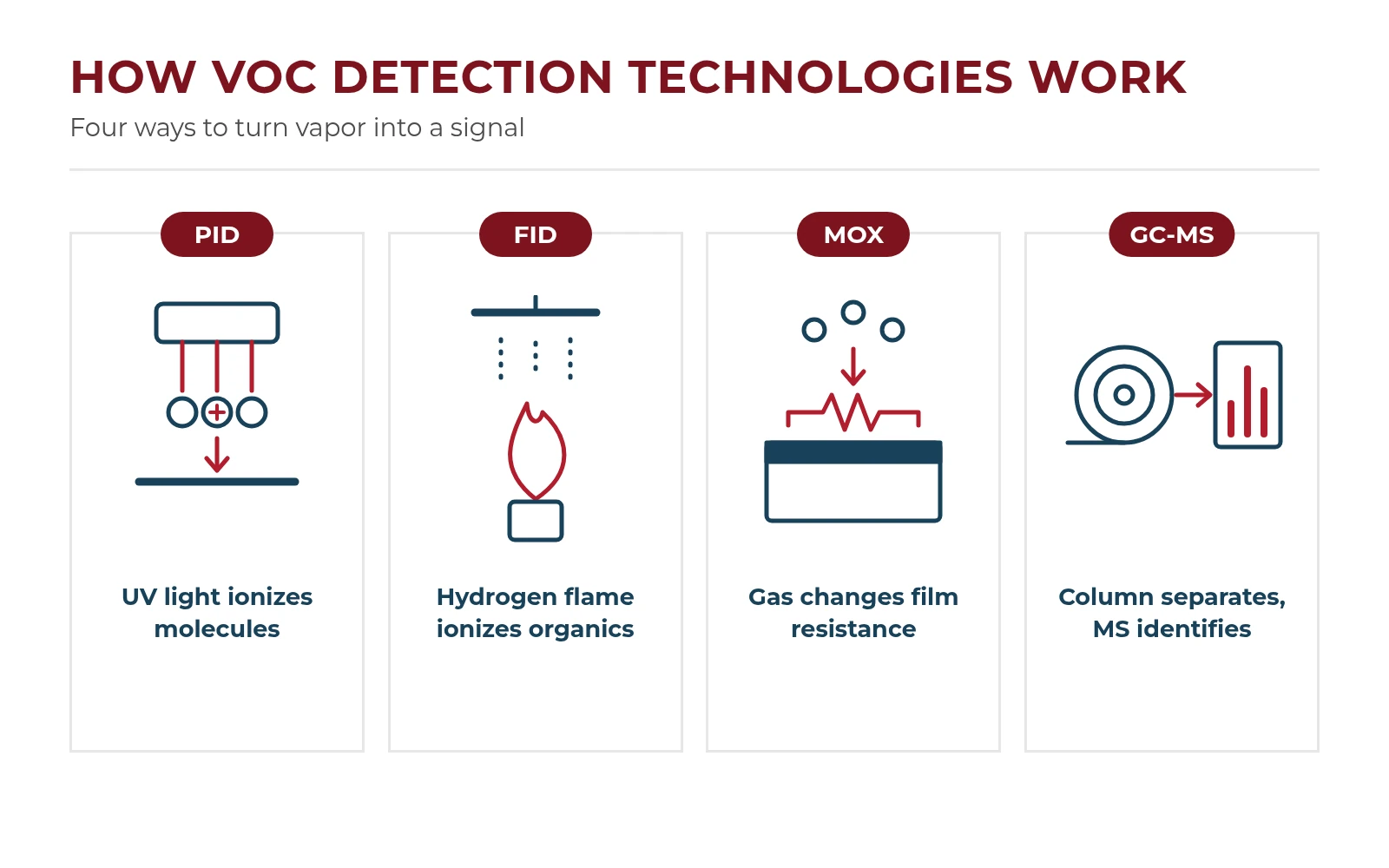
  • Non-selective sensors convert the presence of organic vapours into an electrical signal: PIDs, FIDs, and metal-oxide (MOX) sensors. They give one combined reading and cannot tell you which compounds produced it.
  • Separating methods divide a mixture before detecting it, so individual compounds can be identified and measured: gas chromatography, usually paired with mass spectrometry.

Infrared absorption sits between the two. It can be selective when it is set to a target compound’s wavelength.

Photoionization detectors (PID)

How it works. A PID uses ultraviolet (UV) light to ionize gas molecules. The resulting ions produce a current proportional to concentration. Only a small fraction of molecules is ionized, so the measurement is non-destructive.

Lamp energy. The lamp’s energy determines which compounds can be ionized. A lower-energy lamp makes the PID more selective; a higher-energy lamp makes it more broadly responsive.

Calibration and compound sensitivity. A 1992 EPA survey of portable analyzers notes that isobutylene or benzene is often used as a PID calibration gas (EPA, GD-044). Sensitivity differs from compound to compound, so a reading is relative to the calibration gas. Correction factors convert it when the compound is known.

Methane. A PID does not respond to methane (EPA, GD-044). Methane’s ionization energy, 12.6 eV, is higher than the 9.8, 10.6, and 11.7 eV lamps described in RAE Systems’ Application Note 226.

Humidity. PID response drops slightly as humidity rises, according to RAE Systems’ Application Note 226.

Flame ionization detectors (FID)

How it works. An FID burns the sample in a hydrogen-air flame and measures the ions produced. Its response follows carbon chain length rather than functional groups, so it reads a broad range of hydrocarbons fairly evenly. Unlike a PID, an FID responds to methane.

Limits. The sample is destroyed, so it can’t be kept for further analysis. The flame needs a hydrogen supply and oxygen in the sample.

Regulatory use. EPA Method 25A measures total gaseous organic concentration with a flame ionization analyzer.

Metal-oxide (MOX) sensors

How it works. A MOX sensor uses a thin metal-oxide film whose resistance changes when gases adsorb onto it. A published review of on-site VOC detection describes MOX sensors as the most widely used VOC sensor type. It notes they are small and relatively inexpensive (Epping and Koch, On-Site Detection of Volatile Organic Compounds).

Limits, according to the same review:

  • MOX sensors are non-selective.
  • They also respond to some inorganic gases, such as carbon monoxide and nitrogen oxides.
  • They are affected by temperature and humidity.
  • Their long-term stability is limited.

Infrared absorption

How it works. Compounds absorb infrared (IR) light at characteristic wavelengths. An IR instrument set to the target compound’s absorption wavelength can be selective. Other compounds that absorb at similar wavelengths can cause false positives. EPA Method 21 lists infrared absorption among the detector types that may meet its requirements.

Imaging. OGI cameras also work in the infrared, but they produce an image rather than a reading (see PID vs OGI).

Gas chromatography and GC-MS

How it works. A gas chromatograph separates a mixture into individual compounds before they reach a detector. When the detector is a mass spectrometer, each compound can be identified by when it leaves the column and by its mass spectrum.

Strength. EPA Method TO-15A describes mass spectrometric detection as more definitive for identification than non-specific detectors such as FIDs or PIDs (EPA, Method TO-15A).

Trade-off. GC-MS is usually done in a laboratory on collected samples. That means results are not available on site in real time.

VOC detection technologies compared
Technology What it reports Key limitations Typical role
PID Combined reading, relative to the calibration gas No response to methane; sensitivity varies by compound and lamp; slight humidity effect Portable screening, personal monitoring, leak surveys
FID Combined reading; responds to methane Needs hydrogen and oxygen; destroys the sample Leak surveys, total organic concentration
MOX sensor Combined, TVOC-style reading Non-selective; cross-sensitive to some inorganic gases; temperature, humidity, and stability effects Compact, low-cost monitoring
Infrared absorption Reading for a target compound or class at a set wavelength Interference from compounds that absorb at similar wavelengths Selective measurement when the target is known
GC / GC-MS Individual compounds, identified and quantified Usually lab-based; results are not real-time Identification and compound-specific measurement
Four-panel diagram showing how PID, FID, metal-oxide, and GC-MS methods detect VOCs

VOC Detector vs VOC Monitor vs VOC Meter

Sellers and users apply these names loosely. In this guide:

  • a VOC detector is any instrument that senses and reports VOCs;
  • a VOC monitor is one used to record levels over time, worn by a worker or installed at a location;
  • a VOC meter or VOC tester is a handheld unit that shows a reading on demand.

What matters more than the name is the sensor inside, the form factor, and whether the reading is combined or compound-specific.

Portable and handheld VOC detectors vs fixed monitors

Portable and handheld detectors go where the question is: around a valve, into a work area, or along a survey route. Instruments for leak surveys draw the sample in with a pump through a narrow probe. EPA Method 21 sets the sample flow rate and probe size for instruments used under that method, and requires them to be intrinsically safe for the hazardous locations where they will be used (EPA, Method 21).

Fixed monitors stay at one location and record continuously, which suits trends at a single point rather than searching for a source.

TVOC vs individual VOCs

What a TVOC reading is. In this guide, a TVOC (total volatile organic compounds) reading means the single combined number a non-selective sensor reports for everything it responds to. Epping and Koch say most non-selective sensors can detect the presence and concentration of volatiles in air but cannot speciate them (Epping and Koch). A TVOC reading can therefore show that levels have changed, but not which compounds are present.

Why two TVOC readings rarely match. The number depends on the sensor type and calibration gas. A PID and an FID will not give the same reading on the same gas stream (RAE Systems, Application Note 226). EPA adds that every measurement method is selective, that none measures all VOCs present, and that a statement about VOC levels needs a description of how they were measured to be interpreted correctly.

When you need individual compounds. If you must compare a result against a compound-specific exposure limit, identify a source, or report a specific compound such as benzene, you need a compound-specific method. That means a selective instrument mode or sampling with laboratory analysis. TVOC readings remain useful for screening, trend tracking, and deciding where to sample.

How to Measure VOCs: Direct-Reading Instruments vs Lab Sampling

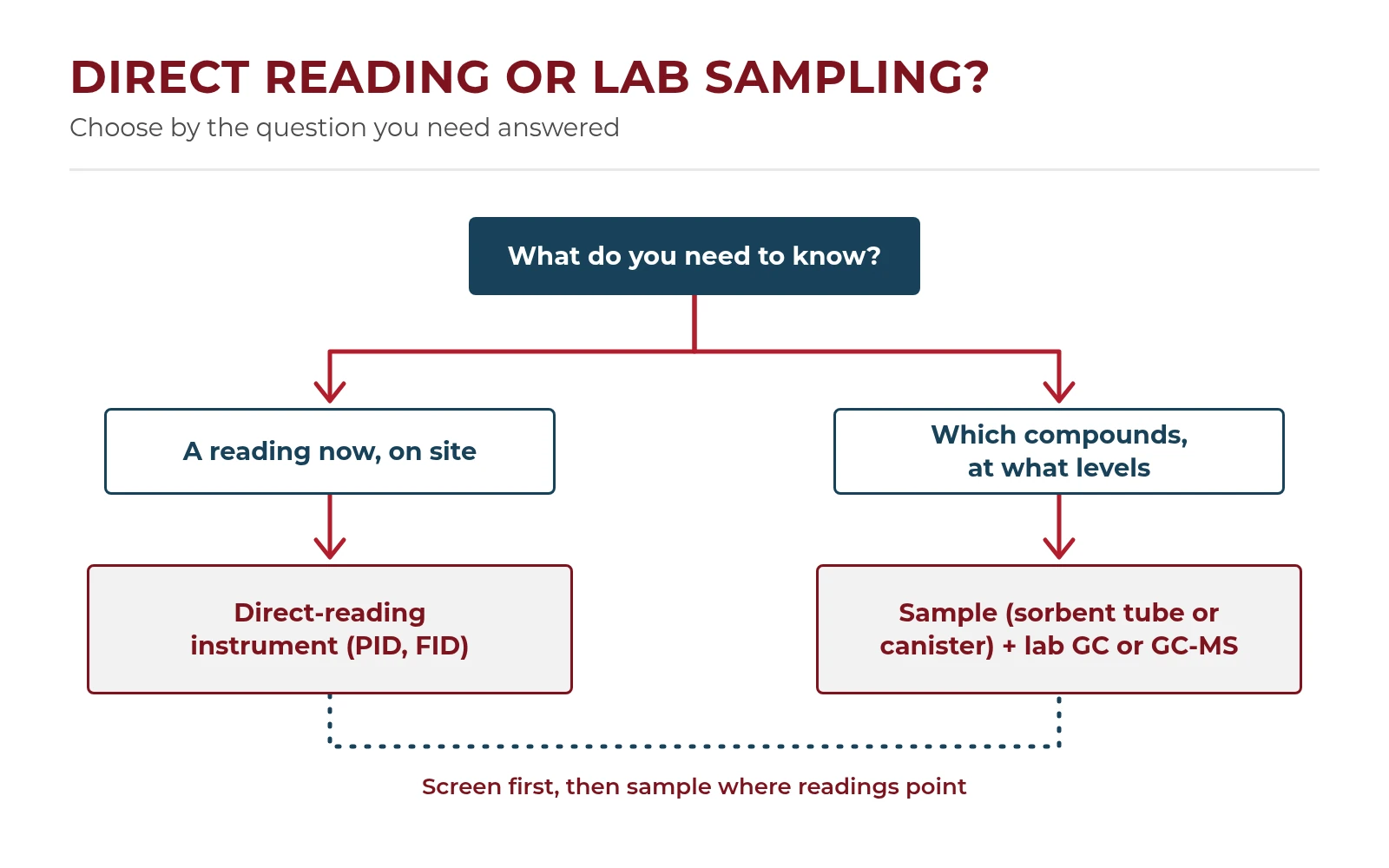
The two approaches answer different questions:

  • Direct-reading instruments give an immediate reading on site. Use them when a decision has to be made on site: whether a space is safe to enter, where a leak is, or whether a level has changed.
  • Sampling with laboratory analysis identifies individual compounds and measures their concentrations. Use it when you need compound identity, trace-level results, a time-weighted average, or a defensible record.

The two can also work in sequence: screen on site, then sample where the screening points.

Direct-reading screening

A direct-reading instrument reports continuously. Its reading reflects the sensor’s response relative to its calibration gas.

EPA Method 21 is a widely referenced example. It specifies a portable instrument to locate and classify VOC leaks from process equipment. Method 21 states that it is not a direct measure of mass emission rate. It does not specify the detector type; catalytic oxidation, flame ionization, infrared absorption, and photoionization detectors may qualify if the instrument meets the method’s specifications. Those specifications include responding to the compounds being processed and having a response factor below 10 for each compound measured, unless the applicable regulation specifies otherwise.

Sorbent tubes and canisters with lab analysis

Two sampling formats cover most VOC work.

Sorbent tubes collect VOCs from air pumped through the tube or diffusing onto it. In the lab, the VOCs are thermally desorbed and analyzed by capillary gas chromatography. ASTM D6196 covers sorbent selection and procedures for ambient, indoor, and workplace air (ASTM D6196). ASTM notes that this approach gives a time-weighted average and cannot capture short-term fluctuations. Pumped sampling uses an air sampling pump.

Canisters collect a whole-air sample in a specially prepared, evacuated stainless-steel canister. The sample can be a quick grab or collected at a controlled rate over hours or days. The lab then separates and identifies compounds by GC-MS. EPA Method TO-15A uses this approach for trace-level VOCs in ambient air. It notes that indoor-air applications fall outside its scope and may need method modifications.

EPA methods you may see referenced

Permits, regulations, and consultant reports often name a method rather than a technology. These are the ones most often tied to VOCs:

EPA methods commonly referenced for VOCs
Method What it determines How
Method 21 Location and classification of VOC leaks from process equipment Portable instrument at each potential leak interface
Method 18 Gaseous organic compound emissions Gas chromatography
Method 25A Total gaseous organic concentration Flame ionization analyzer
Method TO-15A Trace-level VOCs in ambient air Canister sampling with GC-MS analysis
Flowchart for choosing between a direct-reading VOC instrument and lab sampling

VOC Detection in Industrial Settings

Industrial VOC detection serves three main jobs:

  • protecting workers from exposure
  • finding and documenting equipment leaks and emissions
  • monitoring air at sites where toxic vapours are a known hazard

Each job leans on a different combination of the methods above.

Industrial hygiene and worker exposure

Exposure limits are compound-specific. The NIOSH Pocket Guide to Chemical Hazards lists, for hundreds of chemicals:

  • NIOSH recommended exposure limits
  • OSHA permissible exposure limits
  • immediately-dangerous-to-life-or-health values
  • measurement methods

What a direct-reading PID can and can’t do here. A PID can screen a work area quickly. Comparing a reading against a specific limit, however, requires knowing which compound you are reading, and a compound-specific method where mixtures are present.

What a PID doesn’t cover. A PID is a VOC sensor. Epping and Koch note that its UV light ionizes most organic compounds and some inorganic molecules, such as ammonia and hydrogen sulfide, but not the main constituents of air (Epping and Koch). It is not an oxygen or flammable-gas sensor. Work that needs those readings calls for multi-gas monitoring with the appropriate sensors.

Equipment leaks and fugitive emissions

The surveys. Leak detection programs survey valves, flanges, pumps, compressors, and other components for escaping vapour. Method 21 surveys use a portable instrument at each potential leak point. Under rules that reference it, Appendix K to 40 CFR Part 60 sets the protocol for OGI camera surveys.

Where to go next. For program design, see MFE’s guides to LDAR programs and fugitive emissions. For oil and gas rule specifics, see OOOOa requirements.

Check whether the stream is mostly methane. A PID will not see a methane leak. An FID responds to methane, and Appendix K requires OGI cameras to be able to image methane at specified test conditions.

Oil and gas toxic air monitoring

At oil and gas sites, VOC monitoring often sits alongside monitoring for other toxic gases. The specific compounds matter: benzene, for example, has its own exposure limits and calls for compound-specific measurement rather than a TVOC reading. MFE’s guide to oil and gas toxic air monitoring covers that application in depth.

VOC Detection for Indoor Air Quality

What it is. Indoor VOC detection checks the air in homes, offices, schools, and other non-industrial buildings for VOCs released by products and materials.

Sources. EPA lists paints and solvents, cleaners and disinfectants, aerosol sprays, stored fuels, building materials and furnishings, and office equipment such as copiers and printers.

Levels. EPA reports that concentrations of many VOCs are consistently higher indoors than outdoors. During and after activities such as paint stripping, levels can be far higher than outdoor background.

No federal limit. EPA states that no federally enforceable standards have been set for VOCs in non-industrial settings. As a result, there is no single federal number to compare an indoor reading against.

What a TVOC monitor can and can’t tell you. Many indoor air monitors report a TVOC-style value from a non-selective sensor. That makes them useful for spotting changes, such as a rise after painting or cleaning or a drop after ventilating. They can’t identify which compounds are present. EPA’s point about method selectivity applies directly here: an indoor VOC result means little without knowing how it was measured. EPA also notes that formaldehyde is one of the few indoor air pollutants that can be readily measured.

When to go further. When a TVOC reading isn’t enough, the next step is compound-specific sampling with lab analysis:

  • persistent odours or complaints
  • a suspected specific source
  • a need to know which compounds are present

ASTM D6196 sorbent methods include indoor air in their scope. For broader air programs, see MFE’s overview of environmental monitoring.

PID vs Optical Gas Imaging for VOC Leaks

The two tools answer different questions about a leak:

  • A PID measures the concentration of ionizable vapours at the probe tip, as a reading relative to its calibration gas.
  • An OGI camera makes otherwise invisible gas visible on screen, so an operator can see where a leak is across many components.

Appendix K states that its OGI protocol determines the presence and location of leaks and is not currently applicable for direct emission rate measurement. A standard OGI survey therefore does not produce a concentration reading the way a PID does. Quantitative OGI is a separate approach, covered in MFE’s guide to quantitative OGI.

PID vs OGI camera for VOC leak work
PID OGI camera
What it tells you Vapour concentration at the probe, relative to the calibration gas An image of gas escaping, showing where the leak is
Methane No response Appendix K cameras must be able to image methane at specified test conditions
How it covers equipment One point at a time, with the probe at the component Scans scenes containing many components, with minimum dwell times
Conditions that limit it Compound sensitivity and lamp choice; slight humidity effect Temperature contrast, wind, viewing distance, and interferences such as steam, fog, rain, and solar glint
Record it produces Readings, logged if the instrument supports it Video or photographs of detected leaks

Because the tools answer different questions, they can work together. A camera can quickly narrow where to look across a large area. A direct-reading instrument then provides the concentration reading where a rule or procedure requires one. Appendix K also sets training and periodic audit requirements for OGI camera operators. For the camera side of this decision, see MFE’s guide to OGI cameras; for leak tools more broadly, see gas leak detectors and gas leak detection.
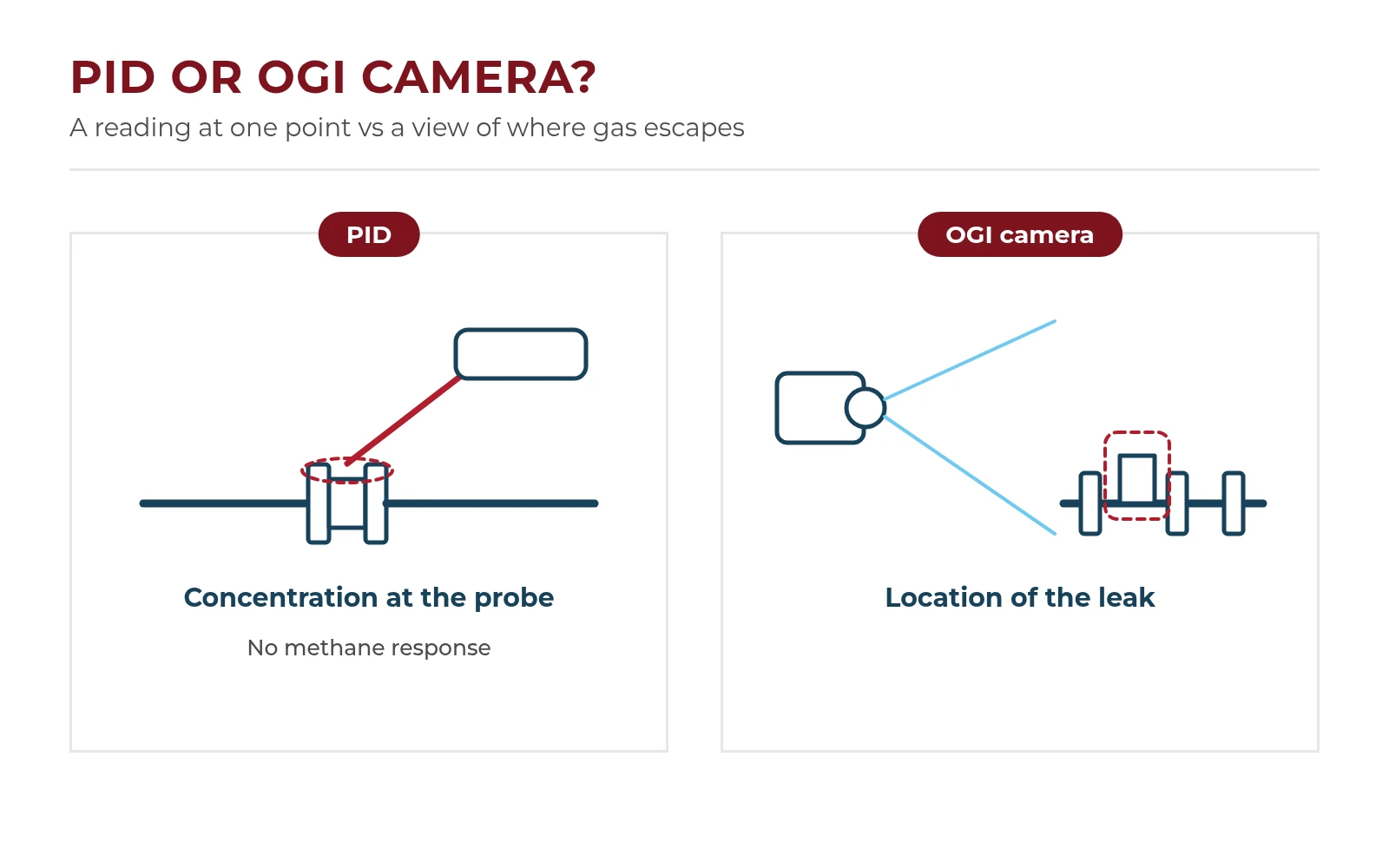
Side-by-side diagram contrasting a PID point reading with an OGI camera view of a leak location

How to Choose a VOC Detector

Choose a VOC detector by starting with the compounds you need to detect and the decision the reading must support, then match the technology, range, and certifications to that work. These questions narrow the field:

  1. Which compounds, and is methane among them? A PID cannot see methane. Methane-dominated leaks call for an FID or an OGI approach that images methane.
  2. Do you need a combined reading or a specific compound? A TVOC-style reading supports screening. A compound-specific limit or report needs a selective mode or lab analysis (see TVOC vs individual VOCs).
  3. What concentration range? Trace work calls for an instrument specified for parts-per-billion readings. Leak surveys under Method 21 require an instrument capable of measuring the leak definition concentration in the applicable regulation.
  4. Which lamp and correction factors (for a PID)? Lamp energy sets which compounds the PID can ionize. Correction factors convert readings when the compound is known. Confirm both against your target compounds.
  5. Will it be used in a hazardous location? Method 21 requires intrinsically safe instruments for the explosive atmospheres they may encounter. Confirm the certification in the specific instrument’s documentation rather than assuming it.
  6. How will it be calibrated? Readings are only as good as calibration. Method 21, for example, specifies calibration gases and calibration precision checks for instruments used under it.
  7. Do you need other gases too? If oxygen, flammability, or toxic gases such as hydrogen sulfide must be read at the same time, a multi-gas instrument may fit better than a single-sensor detector.
  8. What records do you need? Data logging, downloads, and video records matter when results must be documented.

Some VOC detectors are available to rent as well as buy. The offer for each MFE product below is shown on its card.

VOC Detection Equipment

MFE Inspection Solutions offers the following equipment for VOC detection work. Each description uses wording from the product’s MFE page. The offer label is taken from the product page title as of November 18, 2026. The products are grouped as portable VOC detectors and optical gas imaging cameras.

Portable VOC detectors

All four instruments in this group use photoionization detection; the MultiRAE Plus combines a PID with other gas sensors. PIDs do not respond to methane, so a PID reading will not show a methane leak (see PID vs OGI).

1. RAE Systems MiniRAE 3000 PID

RAE Systems MiniRAE 3000 handheld photoionization detector

Offer: Buy or Rent

The MFE product page describes the RAE Systems MiniRAE 3000 PID as a “portable photoionization detector (PID) for volatile organic compounds (VOC)” that “detects VOCs in real-time.”

  • Uses named on the product page: “industrial hygiene, hazardous materials response, and environmental monitoring”

Learn more

2. RAE Systems ppbRAE 3000

RAE Systems ppbRAE 3000 handheld VOC monitor

Offer: Buy or Rent

According to its MFE product page, the RAE Systems ppbRAE 3000 is a “high-sensitivity photoionization detector (PID) for detecting volatile organic compounds (VOC) at parts per billion (ppb) levels.”

Learn more

3. RAE Systems UltraRAE

RAE Systems UltraRAE handheld photoionization detector

Offer: For Rent

The MFE product page describes the RAE Systems UltraRAE as an “advanced photoionization detector (PID) for detecting specific volatile organic compounds (VOC).”

  • Modes named on the product page: “Operates in VOC mode or Benzene-Specific mode”

Learn more

4. RAE Systems MultiRAE Plus

RAE Systems MultiRAE Plus multi-gas detector

Offer: For Rent

The MFE product page explains: “Combining the safety of a Photoionization Detector (PID) with four additional gas sensors, the MultiRAE Plus multi-gas detector…”

  • Sensors listed on the product page: “O2, LEL, PID, and any two plug-in “smart” toxic sensors”

Learn more

Optical gas imaging cameras

These cameras show gas leaks visually rather than measuring concentration. For how OGI cameras compare and where they fit, see MFE’s guide to OGI cameras.

5. FLIR GF320

FLIR GF320 handheld optical gas imaging camera

Offer: For Rent

According to its MFE product page, “The FLIR GF320 is a thermal imaging camera used for detecting and visualizing volatile organic compounds (VOCs).”

Learn more

6. MFE Detect MW (MFE OGI Camera)

MFE Detect MW optical gas imaging camera with handle

Offer: For Rent

The MFE product page describes the MFE Detect MW as “…an optical gas imaging camera designed to detect hydrocarbon gas leaks. This device can be used as a handheld device or a payload.”

Learn more

7. MFE OGI 640

MFE OGI 640 optical gas imaging drone payload

Offer: For Sale

According to its MFE product page, the MFE OGI 640 is “…an optical gas imaging payload that detects and visualizes gas leaks with high precision.”

Learn more

VOC Detection FAQ

What is a VOC meter or VOC tester?

A VOC meter or VOC tester is a handheld instrument that shows a reading of VOCs in air on demand. A meter built on a non-selective sensor, such as a PID or a metal-oxide sensor, reports a combined reading rather than identifying individual compounds. See how VOC detectors work.

Does a PID detect methane?

No. A PID does not respond to methane: its ionization energy is higher than the energy of standard PID lamps. Where methane matters, use an FID or an OGI method that images methane. Methane is also excluded from EPA’s regulatory VOC definition.

Are VOC detectors accurate?

A VOC detector can be accurate for what it actually measures, but that is rarely “all VOCs.” Each sensor reports its response to the compounds it detects, relative to its calibration gas. A PID and an FID will read differently on the same gas stream, and EPA notes that no method measures all VOCs present. Accurate results for a specific compound depend on:

  • calibration
  • the correct correction factor
  • a compound-specific method where mixtures are present

What TVOC level is unhealthy?

There is no single federal number. EPA states that no federally enforceable standards have been set for VOCs in non-industrial settings, and that health effects vary greatly from one organic chemical to another. A TVOC reading can’t be compared with compound-specific limits. For workplace chemicals, exposure limits are listed by compound in the NIOSH Pocket Guide to Chemical Hazards.

Can I use a home VOC monitor at home or at work?

At home: a home VOC monitor can show whether indoor VOC levels are rising or falling.

At work: its TVOC-style reading cannot identify compounds or be compared with compound-specific workplace exposure limits. Workplace exposure assessment and hazardous-location work call for instruments and methods suited to those requirements. See VOC detection in industrial settings.

What is the best VOC detector?

No single VOC detector is best for every job. The right choice depends on:

  • which compounds you need to detect, and whether methane is among them
  • the concentration range
  • whether you need a combined or compound-specific reading
  • the hazardous-location requirements
  • the records you need

Use the questions in how to choose a VOC detector to narrow the options.

How much does a VOC meter cost?

Cost depends on:

  • the sensor technology
  • the measurement range, especially parts-per-billion capability
  • compound-specific modes
  • whether other gas sensors are included
  • hazardous-location certification
  • data and calibration accessories

Renting is another option for some instruments. Use the “Learn more” link on each product card to request current pricing from MFE.

Is a VOC testing kit the same as a VOC meter?

Not necessarily.

  • A VOC meter gives a direct reading on site.
  • A sampling-based test collects air on sorbent media or in a canister for laboratory analysis, which can identify and measure individual compounds.

Check which approach a kit uses before you rely on its results. See how to measure VOCs.

Is natural gas a VOC?

Under EPA’s regulatory definition, its main components are not. Natural gas consists predominantly of methane, and EPA’s regulatory VOC definition excludes methane and ethane as compounds with negligible photochemical reactivity.

Detection is a separate question. Leak detection for natural gas relies on methane-capable methods rather than a PID. See gas leak detectors.