
Guide
Green UAS: The Full Green UAS Cleared List [New for 2026]
Green UAS—sometimes called “green drones”—are drones that have been independently assessed through AUVSI’s Green UAS program and have achieved either Green UAS Cleared or Green UAS Certified status.
The Green UAS program is designed to help buyers identify platforms that meet defined standards for cybersecurity, product security, and supply-chain risk management.
→ Jump to the full Green UAS list
In terms of vetting, Green UAS is closely aligned with Blue UAS. Both programs evaluate cybersecurity and supply-chain trustworthiness, and Green UAS now serves as a streamlined pathway into the broader Blue UAS ecosystem.
The big difference between the two is that Blue UAS is primarily intended for government and defense use, while Green UAS was originally developed for commercial and non-defense organizations seeking a trusted drone standard.
The Green UAS list is relatively small today compared to Blue UAS. But it’s expected to expand over time as more drones complete the certification process.
Keep reading for a closer look at Green UAS: what it is, how certification works, and the full list of approved drones.
Quick Note: Why Green UAS Matters Right Now
In late 2025 and early 2026, new FCC actions increased uncertainty around the long-term availability of new foreign-made drones in the U.S.—especially for organizations that need predictable procurement, support, and compliance.
That shift has made vetted U.S./trusted options (including Green UAS platforms) more relevant for some buyers than they were even a year ago.
Need something specific? Green UAS is only one part of the trusted-drone ecosystem. Use the guides below to compare it with NDAA compliance, Blue UAS, American-made drones, and current DJI-related restrictions.
| If you’re looking for… | Start here |
|---|---|
| A plain-English guide to what NDAA-compliant drones are and how they differ from Blue UAS and Green UAS | NDAA-compliant drones guide |
| A cleared list of Blue UAS drones and what Blue UAS means | Blue UAS guide |
| A guide to American-made drones, U.S.-based manufacturers, and trusted domestic or U.S.-aligned platforms | American-made drones guide |
| What the DJI ban means and how current restrictions affect buyers | DJI ban guide |
| Non-DJI options for commercial, enterprise, and government drone programs | DJI alternatives guide |
The Full Green UAS List
Below is the current list of drone platforms that have publicly achieved Green UAS status through AUVSI’s Green UAS program.
Depending on the manufacturer and certification pathway pursued, a platform may have achieved either Green UAS Cleared or Green UAS Certified status. Both pathways are designed to evaluate cybersecurity, product security, and supply-chain trustworthiness, although Green UAS Certified includes a broader set of assessment areas.
The number of Green UAS platforms remains relatively small compared to Blue UAS. That’s partly because the Green UAS program is newer and continues to evolve, with additional aircraft expected to be added as manufacturers complete the certification process.
This list includes complete drone platforms only. It does not include certified components, subsystems, software products, or other technologies that may also participate in the Green UAS ecosystem.
- AgEagle: eBee TAC
- American Robotics: Optimus 1-EX
- Ascent Aerosystems: Spirit
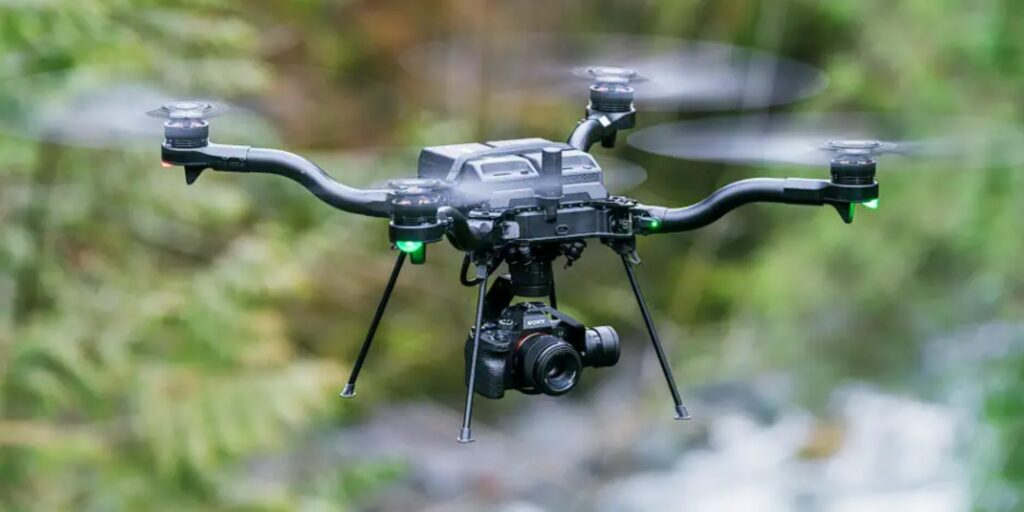
- Freefly Systems: Astro, Alta X
- Hoverfly: Hoverfly Spectre
- Inspired Flight Technologies: IF800 Tomcat, IF1200A
- Skyfront: Perimeter 8
- Vantage Robotics: Vantage Vesper
- Vector: Longbow
- Wingtra: WingtraOne Gen II, WingtraRAY
- WISPR: SkyScout 2+
Note: Some manufacturers market drones as “Green UAS aligned” or “Green UAS ready,” but this list includes only platforms that have publicly announced Green UAS Cleared or Green UAS Certified status. Additional aircraft will likely be added as certifications become public.
The Best Green UAS Drones for Industrial Inspections
Not every Green UAS platform is designed for inspection work.
Many were developed primarily for defense, public safety, mapping, or other specialized missions.
The drones below stand out because they combine Green UAS status with industrial inspection capabilities.
Rather than ranking these platforms from best to worst, it’s more useful to think about where each one fits. Some are optimized for heavy-lift sensor payloads, others for autonomous operations, and others for compact deployment in challenging environments.
1. Freefly Alta X
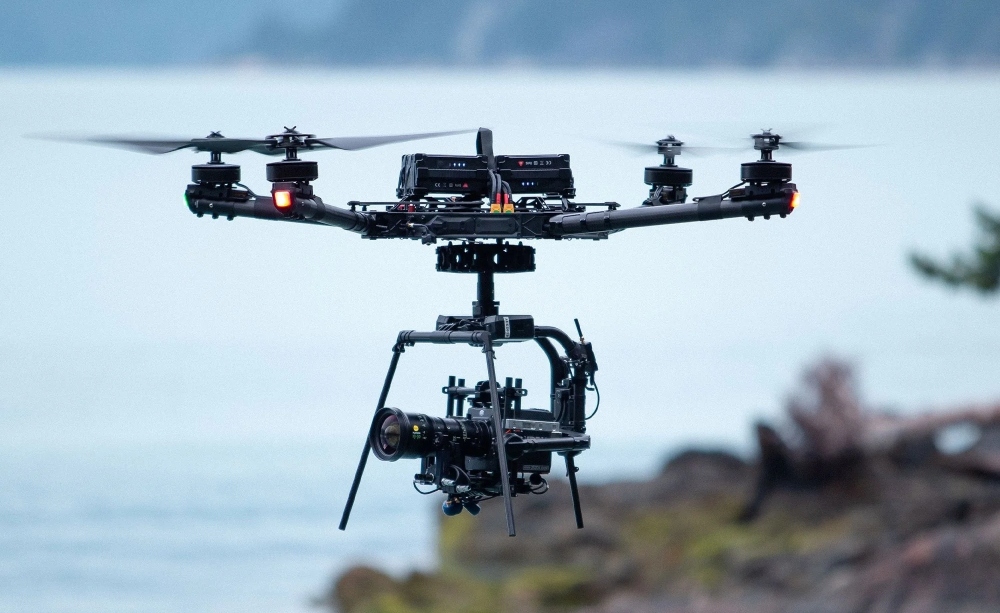
The Freefly Alta X is best suited for inspection programs that need to carry larger payloads, such as LiDAR systems, multi-sensor packages, or specialized imaging equipment.
Its modular architecture and heavy-lift capability make it a strong fit for advanced data collection workflows where payload flexibility matters more than portability.
Best fit for:
- Heavy-lift inspection and mapping missions
- LiDAR, high-end cameras, and multi-sensor payloads
- Custom sensor integrations
Learn more about the Freefly Alta X.
2. Freefly Astro
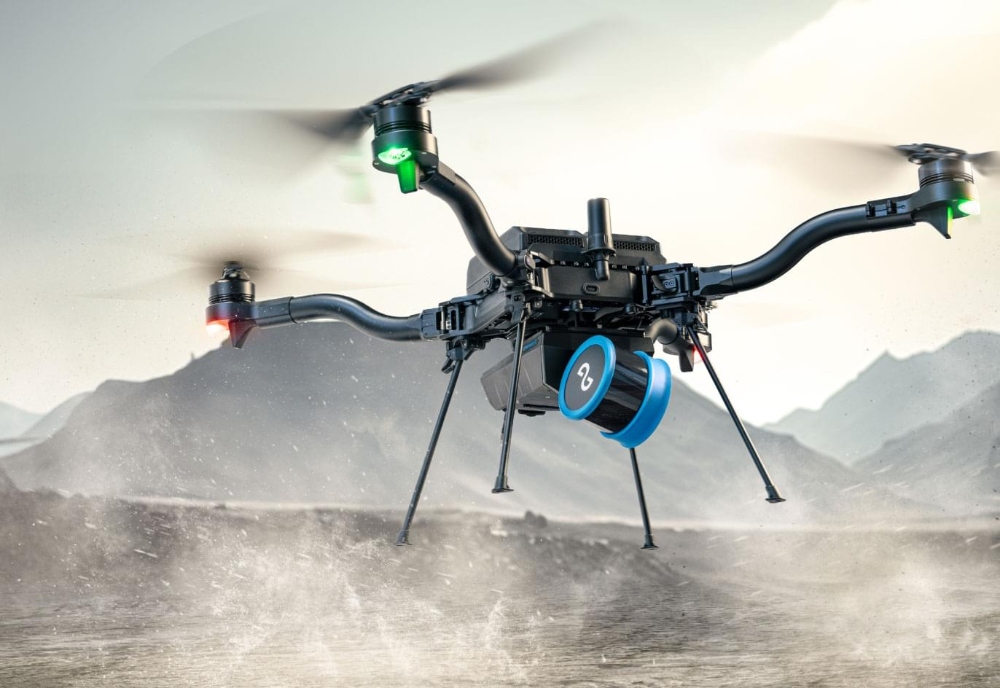
The Freefly Astro is a compact enterprise drone designed for organizations that need a balance of portability, performance, and operational simplicity.
Its smaller form factor makes it well suited for inspection teams that frequently deploy in the field and need a platform that can be transported and launched quickly.
Best fit for:
- General infrastructure inspections
- Visual inspection workflows
- Programs that prioritize portability and ease of deployment
Learn more about the Freefly Astro.
3. Inspired Flight IF800 Tomcat
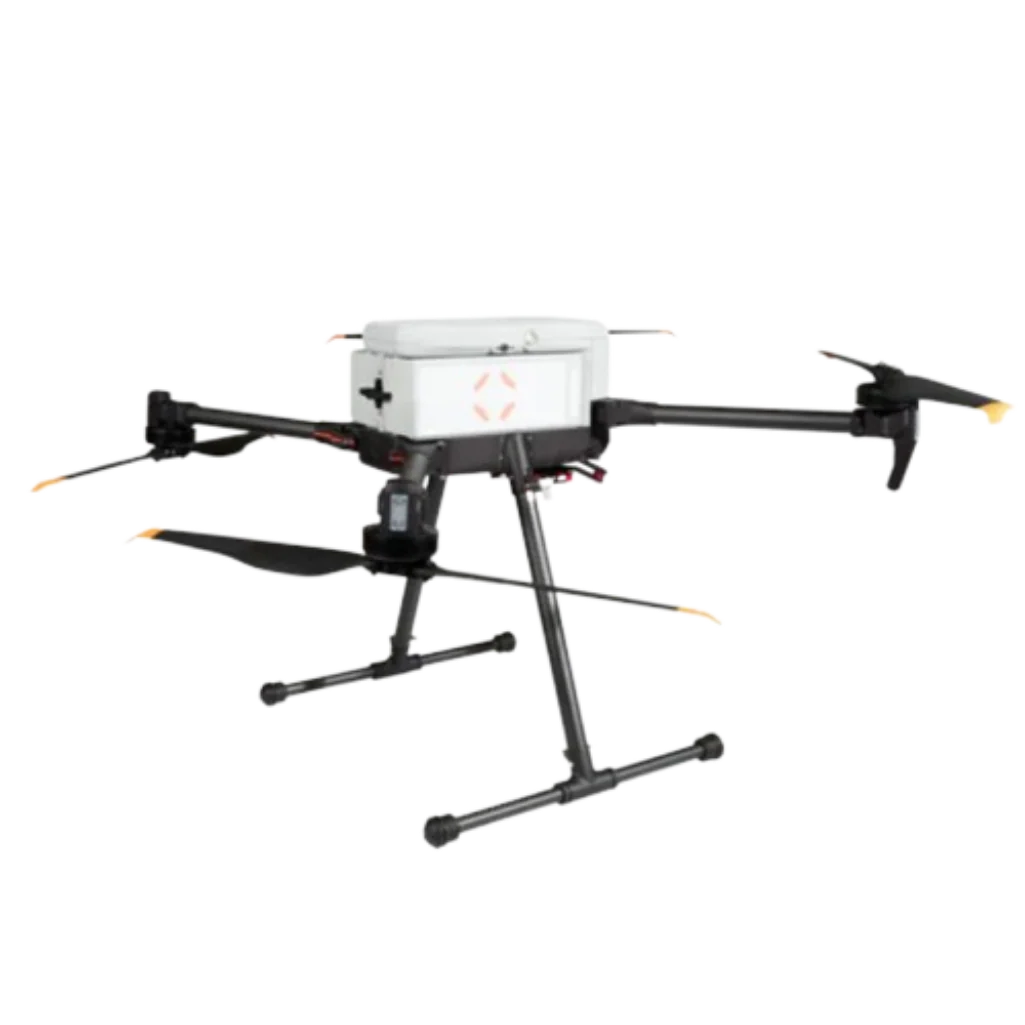
The IF800 Tomcat is often a strong fit for organizations that need a balance between payload flexibility and field deployability.
It supports a range of inspection and mapping sensors while remaining more portable than many heavy-lift systems.
Best fit for:
- Utility and energy inspections
- LiDAR and photogrammetry missions
- Organizations that need flexibility across multiple workflows
Learn more about the Inspired Flight IF800 Tomcat.
4. Inspired Flight IF1200A
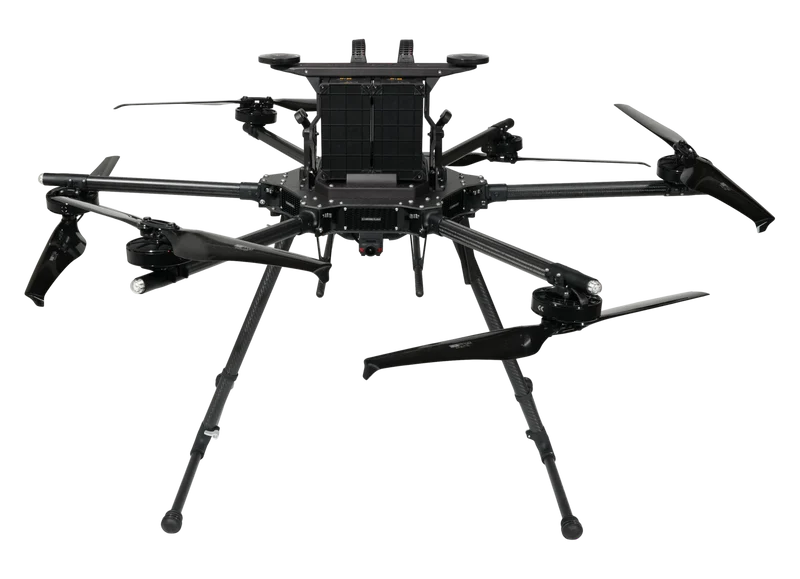
The IF1200A is designed for missions that require larger sensors and heavier payload configurations.
Its lifting capacity makes it particularly relevant for advanced mapping, LiDAR, and specialized inspection workflows where smaller aircraft may be limited.
Best fit for:
- Large LiDAR payloads
- Custom inspection sensor packages
- Large-scale infrastructure and utility projects
Learn more about the Inspired Flight IF1200A.
5. American Robotics Optimus 1-EX
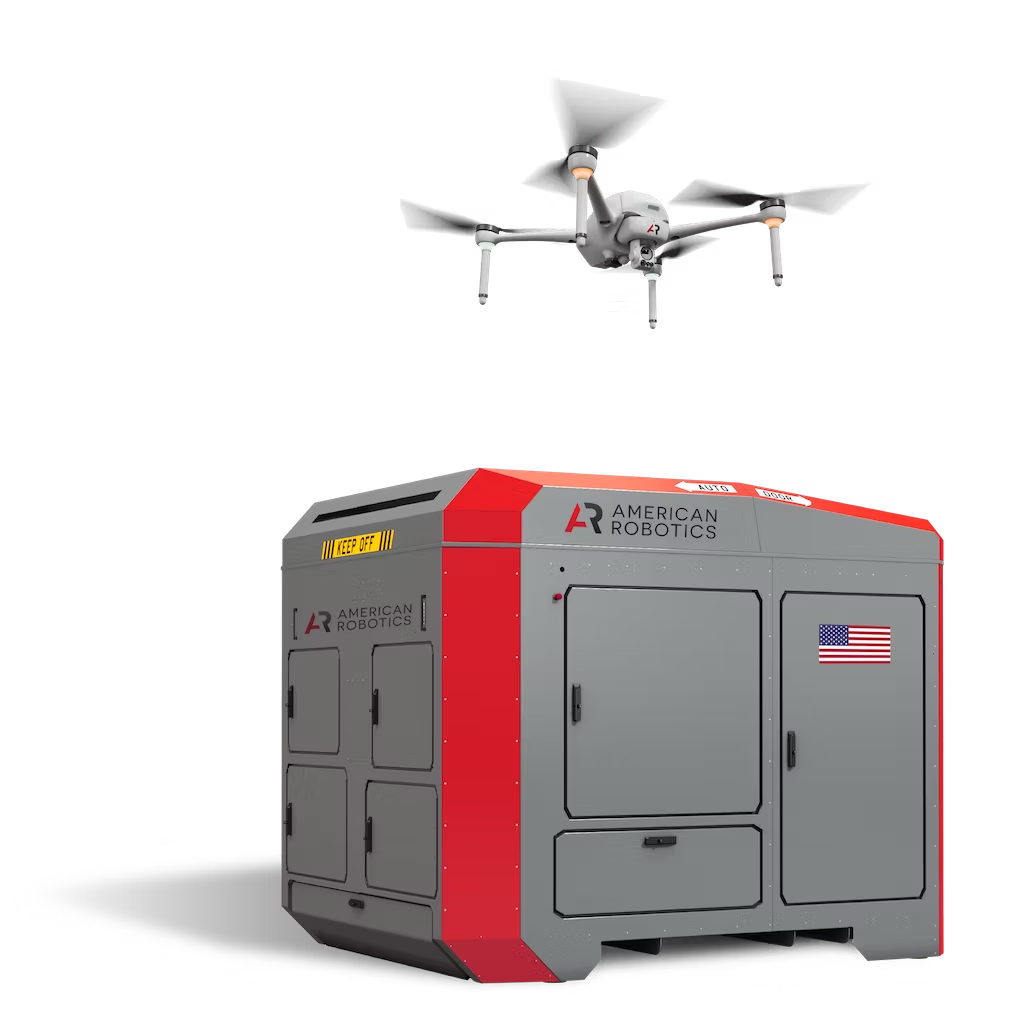
The Optimus 1-EX is differentiated by its autonomous operating model.
It is most relevant for organizations interested in recurring inspections, automated monitoring programs, and repeatable data collection across distributed assets.
Best fit for:
- Automated inspection workflows
- Recurring infrastructure monitoring
- Large or geographically distributed asset networks
Learn more about the Optimus 1-EX.
6. Ascent Aerosystems Spirit
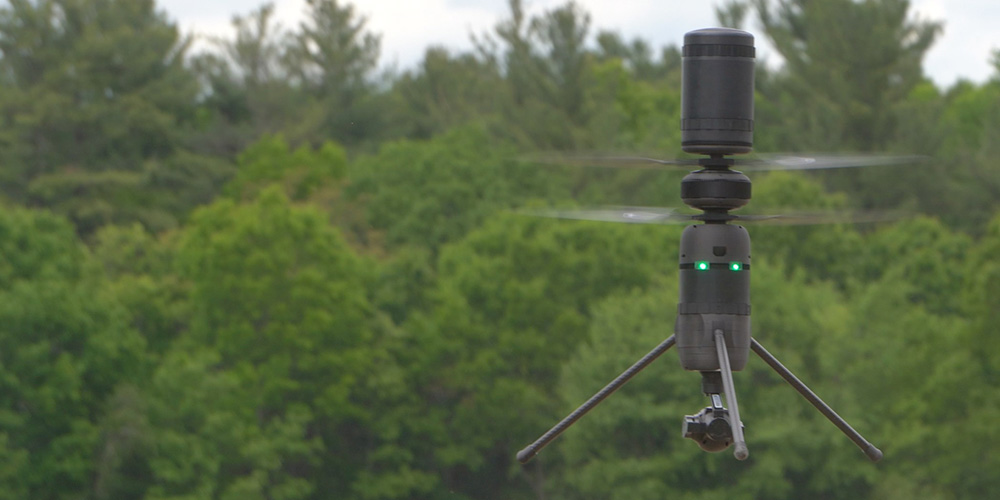
The Ascent Aerosystems Spirit is a rugged UAV designed for operations in challenging environments where durability and compact deployment are priorities.
Its cylindrical design differs significantly from traditional multirotors and can be advantageous in environments where portability and resilience matter.
Best fit for:
- Challenging field environments
- Programs prioritizing ruggedness and portability
- General infrastructure inspections
Learn more about the Ascent Aerosystems Spirit.
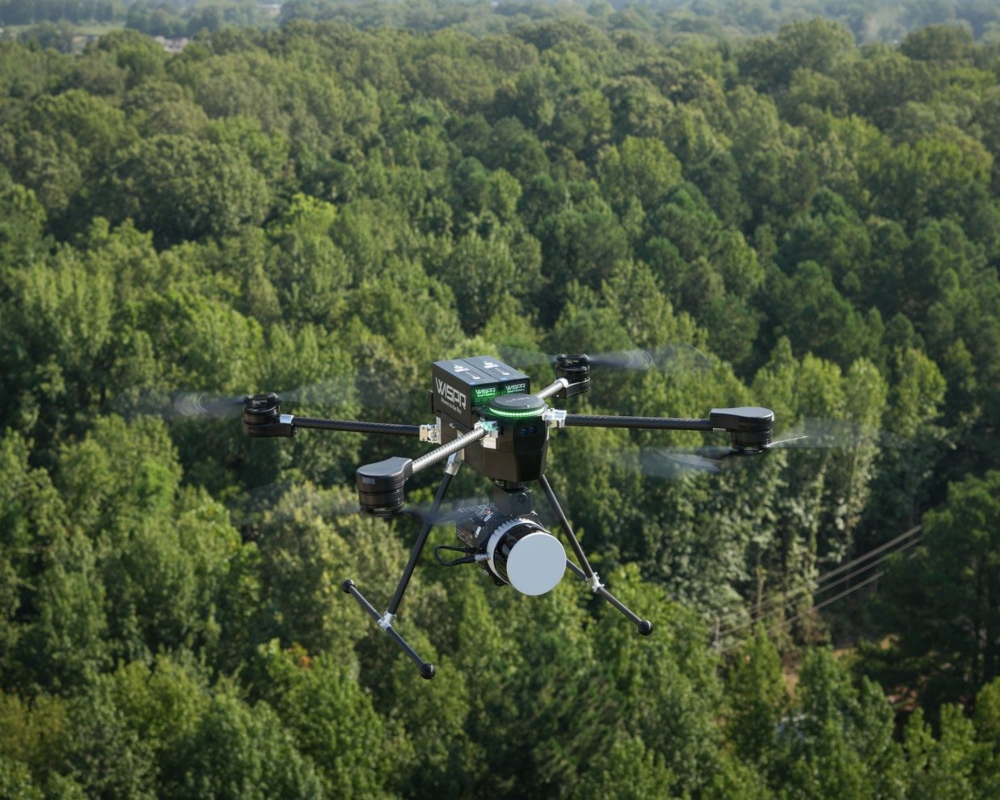
7. WISPR SkyScout 2+
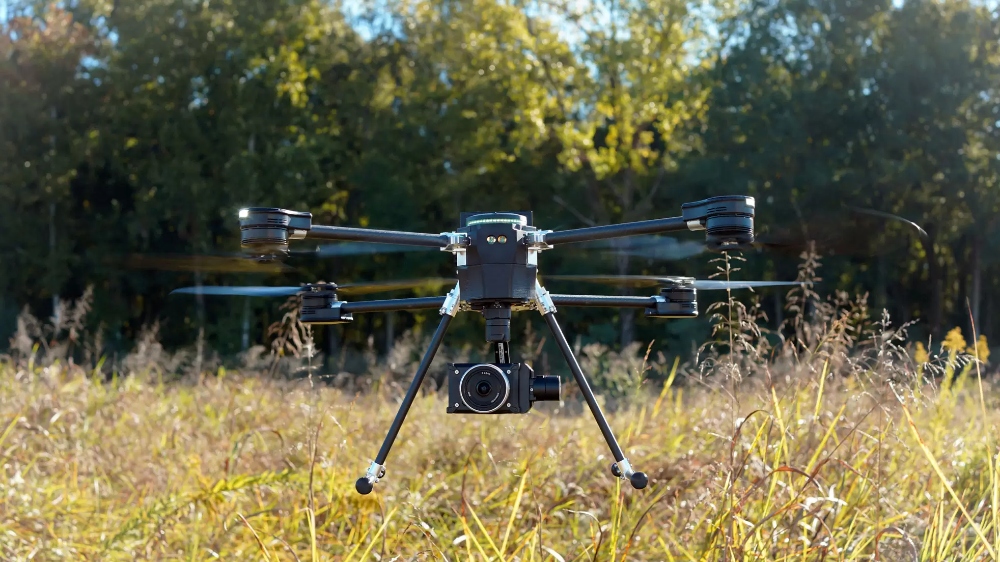
The WISPR SkyScout 2+ is a VTOL platform designed for organizations that need the efficiency of fixed-wing flight combined with the operational flexibility of vertical takeoff and landing.
This combination can be valuable for infrastructure inspections and mapping missions covering larger areas.
Best fit for:
- Corridor inspections
- Large-area infrastructure assessments
- VTOL mapping workflows
Learn more about the WISPR SkyScout 2+.
8. Vantage Robotics Vesper
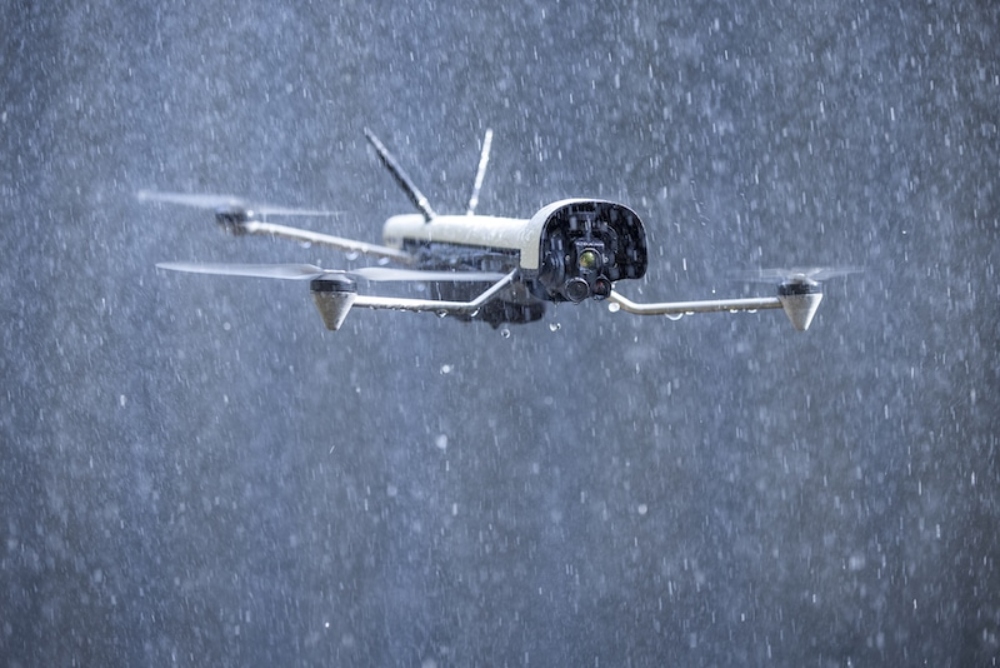
The Vantage Vesper is a compact drone designed for close-range operations where maneuverability and portability are important.
Its small size can make it useful in environments where larger aircraft would be more difficult to deploy effectively.
Best fit for:
- Close-range visual inspections
- Operations with limited launch space
- Programs prioritizing portability
Learn more about the Vantage Vesper.
Most inspection teams evaluating Green UAS platforms are not choosing between all of these drones. In practice, the decision usually comes down to workflow requirements.
Organizations focused on LiDAR or advanced payloads often gravitate toward platforms like the Alta X or IF1200A, while those interested in autonomous monitoring may be better served by systems such as the Optimus 1-EX.
Understanding the inspection workflow is typically more important than selecting a drone based solely on its Green UAS status.
What Is a Green Drone?
A Green UAS—sometimes called a “green drone”—is a drone that has achieved Green UAS status through AUVSI’s Green UAS program, an independent certification framework designed to evaluate cybersecurity, product security, and supply-chain trustworthiness.
The program was originally developed to help commercial and public-sector organizations identify trusted drone platforms without requiring the more restrictive review process associated with Blue UAS.
Today, Green UAS serves a broader role. In addition to supporting commercial procurement decisions, it also functions as a streamlined pathway into the Blue UAS ecosystem through the newer Green UAS Cleared and Green UAS Certified certification pathways.
Unlike Blue UAS, which is intended primarily for Department of Defense and federal procurement, Green UAS provides a framework that can be used by commercial organizations, critical infrastructure operators, public agencies, and government-adjacent industries evaluating drone security and supply-chain risk.
The program is best understood as an effort to create greater transparency around drone security, supply-chain practices, and vendor trustworthiness so buyers can make more informed procurement decisions.
What the Green UAS Program Is Trying to Solve
As concerns around data security, cybersecurity, and foreign-manufactured drone technology have grown, many organizations have struggled to evaluate whether a drone platform aligns with their internal risk and procurement requirements.
Green UAS was created to provide a more consistent and independently validated approach to evaluating those concerns.
The program aims to:
- Provide an independent framework for evaluating drone security and supply-chain practices
- Reduce reliance on self-declared compliance claims by manufacturers
- Help commercial, public-sector, and critical infrastructure operators make more informed procurement decisions
- Create a scalable pathway toward Blue UAS alignment for manufacturers pursuing higher levels of assurance
What Green UAS Is Not
It’s just as important to understand what Green UAS does not represent.
Being Green UAS does not mean:
- The drone is automatically approved for Department of Defense procurement
- The platform satisfies mission-specific military requirements
- Organizations are required to use it
Green UAS is best viewed as a trust and assurance framework rather than a mandate.
Whether it matters for a particular organization depends on procurement requirements, risk tolerance, customer expectations, and operational environment.
For some buyers, Green UAS certification may be a meaningful differentiator. For others, operational requirements, payload capabilities, support, and workflow fit may be more important considerations.
Green UAS vs. Blue UAS vs. NDAA-Compliant Drones
Green UAS, Blue UAS, and “NDAA-compliant” are often used interchangeably—but they represent different programs, requirements, and levels of independent review.
This chart breaks down the terms and what they mean in practice.
| Label | Who it’s for | What it actually signals | Supply chain | Cybersecurity vetting | Procurement impact |
|---|---|---|---|---|---|
| Blue UAS | Federal and defense users | DoD-vetted trusted drone platform for federal use | Strict scrutiny | High (government-grade expectations) | Often simplifies federal procurement |
| Green UAS | Commercial, public-sector, critical infrastructure, and defense-adjacent organizations | Independent cybersecurity and supply-chain certification through Green UAS Cleared or Green UAS Certified | Strong emphasis | High (independently assessed) | Can support procurement, vendor selection, and Blue UAS alignment |
| NDAA-compliant | Organizations that need to avoid covered components or restricted suppliers | A supply-chain restriction baseline—not a security certification by itself | Primary focus | Varies (often self-asserted unless also Green UAS or Blue UAS) | Common procurement requirement, but not a guarantee of cybersecurity |
How to Think About These Labels
A helpful way to think about these categories is as a spectrum of assurance.
- Blue UAS sits at the highest-assurance end for federal and defense use.
- Green UAS provides independent cybersecurity and supply-chain certification for commercial, public-sector, critical infrastructure, and defense-adjacent organizations.
- NDAA-compliant is often the baseline supply-chain requirement—but it does not automatically mean a drone has undergone independent cybersecurity review. In many cases, NDAA compliance is self-asserted by the manufacturer.
Blue UAS
Blue UAS is a Department of Defense initiative focused on identifying drone platforms that meet federal security, supply-chain, and procurement requirements.
If your work involves federal procurement, defense contracts, or mission environments that require DoD-vetted technology, Blue UAS is often the most direct path.
If you want the full list and deeper background, see our guide here: Blue UAS (Blue Drones) Guide.
Green UAS
Green UAS is an independent certification program administered by AUVSI that evaluates cybersecurity, product security, and supply-chain trustworthiness.
Originally created for commercial and public-sector users, the program now also serves as a streamlined pathway into the broader Blue UAS ecosystem through the Green UAS Cleared and Green UAS Certified certification pathways.
For many organizations, Green UAS provides a middle ground between self-asserted NDAA compliance and the more restrictive Blue UAS process. It offers independent validation while remaining relevant to commercial, critical infrastructure, public-sector, and defense-adjacent operations.
NDAA-Compliant Drones
NDAA compliance is primarily about supply-chain restrictions.
It can be an important procurement requirement, but it is not the same thing as an independent cybersecurity evaluation.
That is why some buyers prefer Green UAS or Blue UAS when they need third-party validation of security posture—not just a compliance statement.
If you want the full list and deeper background, see our guide here: What Are NDAA-Compliant Drones?.
Which One Do You Actually Need?
In many cases, the answer is that you may not need any of these designations.
If you are not working with sensitive data, government customers, critical infrastructure, or procurement-driven requirements, a standard commercial platform may be perfectly appropriate.
If you do need a trusted-drone designation, a useful rule of thumb is:
- Blue UAS if the end user is federal or defense procurement.
- Green UAS if you want independent cybersecurity and supply-chain certification without requiring full Blue UAS participation.
- NDAA-compliant if you primarily need to satisfy supply-chain restrictions or procurement requirements.
How Does Green UAS Certification Work?
Green UAS certification is administered by AUVSI and is designed to evaluate cybersecurity, product security, and supply-chain trustworthiness across drones, components, and software.
Originally developed for the commercial market, Green UAS has evolved into a broader certification framework that now aligns closely with the Defense Innovation Unit (DIU) Blue UAS process. As a result, Green UAS can serve as a streamlined pathway for manufacturers seeking entry into the broader Blue UAS ecosystem.
Today, AUVSI offers two Green UAS certification pathways: Green UAS Cleared and Green UAS Certified.
| Certification Path | Product & Device Security | Supply Chain Risk Management | Corporate Cyber Hygiene | Remote Operations & Connectivity |
|---|---|---|---|---|
| Green UAS Cleared | ✓ | ✓ | — | — |
| Green UAS Certified | ✓ | ✓ | ✓ | ✓ |
At a high level, Green UAS Cleared evaluates the two foundational framework areas used for Blue UAS alignment, while Green UAS Certified includes all four framework areas for a more comprehensive review.
Green UAS Cleared
Green UAS Cleared is the streamlined certification pathway.
It was designed to align closely with Blue UAS Cleared requirements while reducing the time and effort required for manufacturers to complete the review process.
Rather than evaluating all four Green UAS framework areas, Green UAS Cleared focuses on the two foundational categories used for alignment with Blue UAS Cleared requirements:
- Product and Device Security
- Supply Chain Risk Management
This pathway is generally intended for manufacturers primarily interested in demonstrating alignment with Blue UAS requirements and trusted supply-chain practices.
Green UAS Certified
Green UAS Certified is the original and more comprehensive version of the program.
It includes the same foundational reviews required for Green UAS Cleared but adds two additional framework areas intended to provide broader organizational and operational assurance.
In addition to Product and Device Security and Supply Chain Risk Management, Green UAS Certified evaluates:
- Corporate Cyber Hygiene
- Remote Operations and Connectivity
This more extensive review is often most relevant for organizations supporting critical infrastructure, government-adjacent operations, or customers that require a broader cybersecurity assessment.
The Four Green UAS Evaluation Frameworks
While Green UAS Cleared evaluates only two core framework areas, Green UAS Certified evaluates all four.
Together, these frameworks are intended to assess whether a system is designed, sourced, secured, and supported in a way that promotes trustworthy deployment.
1. Product and Device Security
This framework evaluates the security of the aircraft, software, and supporting systems themselves.
Key considerations may include secure communications, protection against unauthorized access, and controls around how operational data is stored and transmitted.
The goal is to reduce the risk that sensitive information or mission-critical systems can be compromised.
2. Supply Chain Risk Management
Supply-chain integrity remains a core focus of Green UAS.
This framework evaluates where critical components originate, whether suppliers present potential security concerns, and how transparent manufacturers are about sourcing practices.
For many buyers, this is one of the most important parts of the certification because it helps address concerns about future restrictions, procurement eligibility, and long-term supportability.
3. Corporate Cyber Hygiene
This framework looks beyond the drone itself and evaluates the manufacturer’s broader cybersecurity practices.
Areas of focus may include internal security policies, vulnerability management processes, access controls, and how the organization manages cyber risk over time.
The intent is to assess whether security is embedded throughout the company, not just within the product.
4. Remote Operations and Connectivity
The final framework focuses on communications security and connected operations.
This includes how systems handle remote communications, network connectivity, and the secure transmission of operational data.
As drones become more integrated into enterprise and government workflows, secure connectivity has become an increasingly important part of overall platform trustworthiness.
Green UAS Certification Cost
There is no single fixed cost for Green UAS certification.
Costs vary based on factors such as platform complexity, documentation readiness, software scope, testing requirements, and whether a manufacturer is certifying a single product or an entire portfolio.
For manufacturers, expenses may include engineering effort, documentation preparation, testing, assessment fees, and remediation work if issues are identified during review.
Green UAS Cleared was specifically designed to streamline alignment with Blue UAS requirements, which is one reason many manufacturers use it as a stepping stone toward broader government and defense opportunities.
For buyers, certification costs are ultimately reflected in product pricing, but they also provide a degree of independent assurance that can reduce procurement risk.
Green UAS FAQ
Here are answers to some of the most common questions about Green UAS, Green UAS certification, and trusted drone programs.
What is Green UAS?
Green UAS is an AUVSI-administered certification program that evaluates drones, components, and software for cybersecurity, product security, and supply-chain trustworthiness.
Originally developed for commercial and public-sector users, Green UAS now also serves as a streamlined pathway into the broader Blue UAS ecosystem through the Green UAS Cleared and Green UAS Certified certification pathways.
Who manages the Green UAS program?
The Green UAS program is administered by AUVSI (the Association for Uncrewed Vehicle Systems International).
While Green UAS aligns closely with Blue UAS and the Defense Innovation Unit (DIU), it is not itself a Department of Defense program.
What is the Green UAS list?
The Green UAS list consists of drone platforms that have publicly achieved Green UAS status through either the Green UAS Cleared or Green UAS Certified pathway.
The list remains smaller than the Blue UAS ecosystem and is expected to expand as additional manufacturers complete the certification process.
Is the Green UAS list the same as the AUVSI list?
Generally, yes.
When people refer to the Green UAS list, they are usually referring to platforms that have publicly achieved Green UAS status through AUVSI’s certification program. AUVSI also evaluates components and software, but this guide focuses only on complete drone platforms.
What’s the difference between Green UAS and Blue UAS?
Blue UAS is intended primarily for Department of Defense and federal procurement environments.
Green UAS provides independent cybersecurity and supply-chain certification that can be used by commercial organizations, critical infrastructure operators, public agencies, and defense-adjacent organizations. Green UAS Cleared also serves as a streamlined pathway toward Blue UAS alignment.
For a deeper dive into Blue UAS, see our guide.
How does Green UAS compare to NDAA-compliant drones?
NDAA compliance primarily addresses supply-chain restrictions and covered entities.
Green UAS goes beyond NDAA compliance by incorporating independent evaluation of cybersecurity, product security, and supply-chain practices. For many buyers, Green UAS provides a higher level of assurance than NDAA compliance alone.
What is the difference between Green UAS Cleared and Green UAS Certified?
Green UAS Cleared is the streamlined certification pathway and focuses on Product and Device Security and Supply Chain Risk Management.
Green UAS Certified includes those same framework areas plus Corporate Cyber Hygiene and Remote Operations & Connectivity, resulting in a broader assessment of organizational and operational security practices.
Are Green UAS drones required for commercial or industrial use?
No.
Most commercial, industrial, and inspection programs are not required to use Green UAS platforms. The certification should generally be viewed as a trust and assurance framework rather than a mandate.
Whether Green UAS matters depends on an organization’s procurement requirements, risk tolerance, customer expectations, and operational environment.
What are the Green UAS requirements?
Green UAS evaluates platforms using four framework areas:
- Product and Device Security
- Supply Chain Risk Management
- Corporate Cyber Hygiene
- Remote Operations and Connectivity
Green UAS Cleared evaluates the first two framework areas, while Green UAS Certified evaluates all four.
How much does Green UAS certification cost?
There is no fixed certification cost.
Costs vary based on factors such as platform complexity, documentation requirements, software scope, testing effort, and the number of products being evaluated.
For buyers, these costs are ultimately reflected in the price of the platform.
Does Green UAS mean a drone is made in the United States?
Not necessarily.
Green UAS evaluates cybersecurity, product security, and supply-chain trustworthiness rather than country of origin alone. A platform can achieve Green UAS status without being fully manufactured in the United States.
Are Green UAS drones a replacement for DJI?
Not in most cases.
While Green UAS platforms can serve as alternatives for organizations with heightened security, procurement, or compliance requirements, many operators will find that standard commercial drones remain appropriate for their missions.
If you’re evaluating alternatives, you may also find these guides helpful: