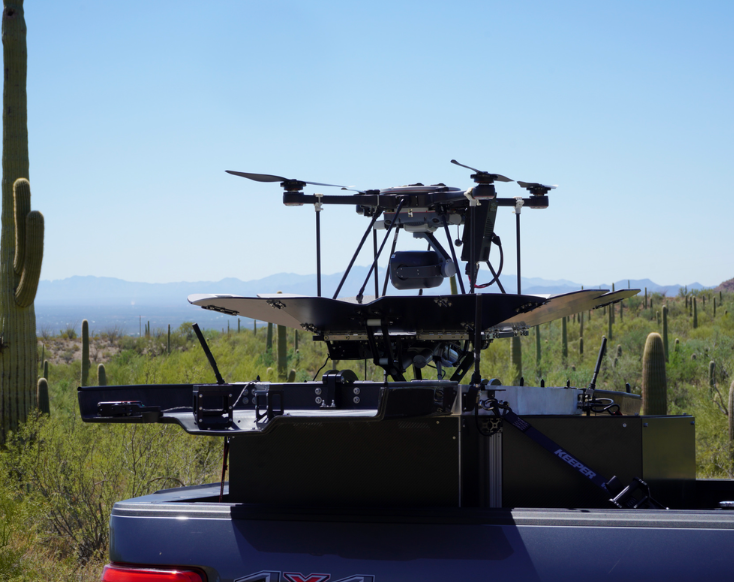
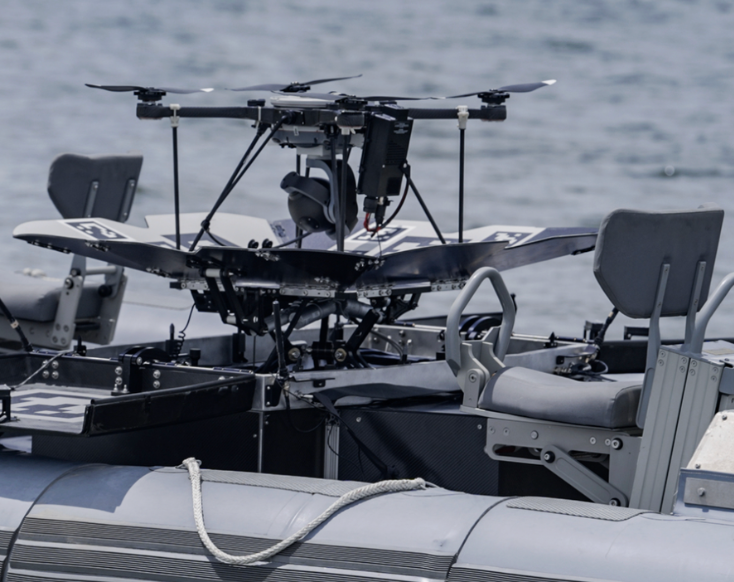
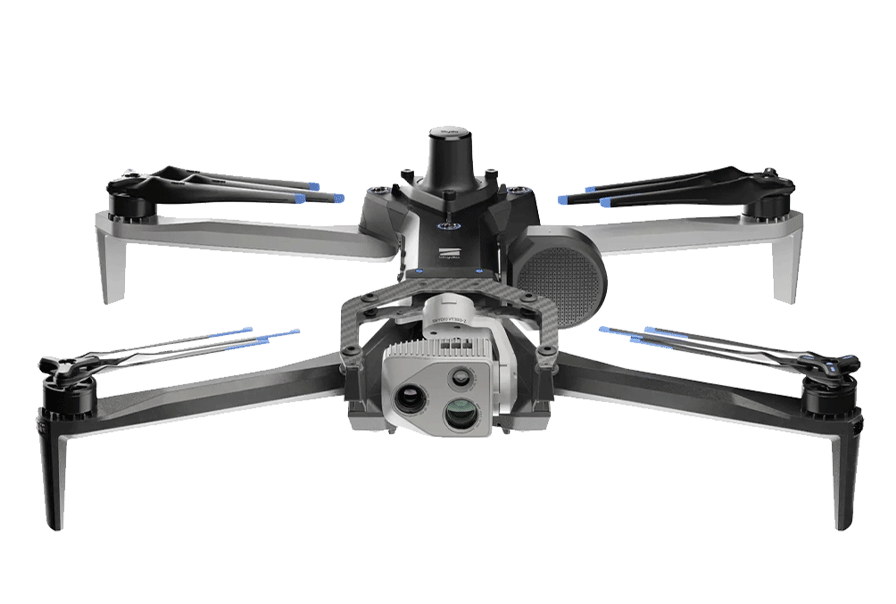
The Teledyne FLIR SkyCarrier is an autonomous drone storage, launch, and recovery system built for SkyRanger R70 and R80D SkyRaider drones.
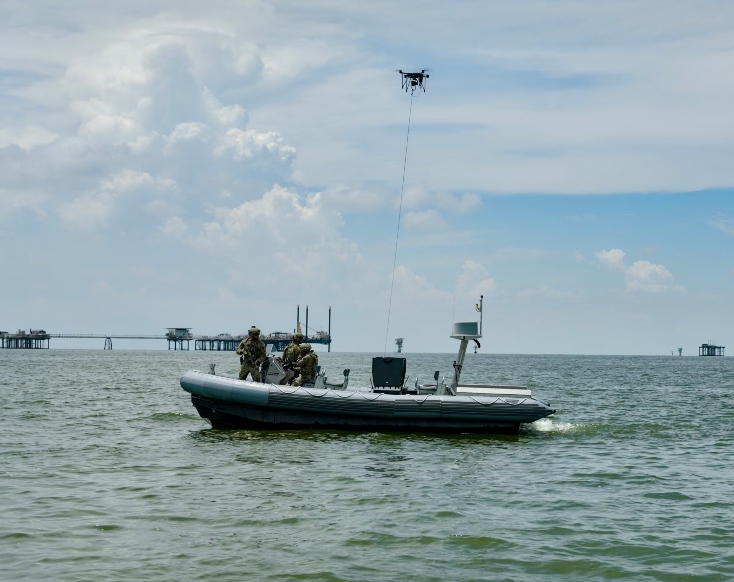
It can be integrated with land vehicles and maritime vessels or installed at a fixed location, allowing the drone to launch and return autonomously—even while the deployment platform is moving.
Equipment Type: Autonomous Drone Launch and Recovery System
Support Repeatable Aerial Data Collection from Remote Deployment Points
Recurring inspections and monitoring programs often require teams to collect aerial data across large sites, remote infrastructure, or assets that are hard to access from the ground.
The SkyCarrier provides a dedicated deployment point for compatible Teledyne FLIR drones. It stores the drone and supports autonomous launch and recovery from a fixed installation, land vehicle, or maritime vessel, allowing organizations to position the system around the requirements of the site.
More than Just a Drone Dock
Unlike a conventional drone dock, the SkyCarrier can launch and recover aircraft while integrated with a moving vehicle or vessel. The free-flight configuration supports launch and landing at speeds up to 30 mph (50 km/h), while the tethered configuration supports speeds up to 28 mph (45 km/h).
Active articulation compensates for deployment-platform tilt up to 20°, helping the system maintain the positioning required for launch and recovery on inclined terrain or moving platforms. AI-based visual markers provide additional guidance for precision landing as the aircraft returns to the SkyCarrier.
Deploy from Vehicles, Vessels, or Fixed Installations
The SkyCarrier can be integrated with a land vehicle or maritime vessel or installed at a fixed location. These installation options allow organizations to place the system where it can best support the assets, inspection routes, and operating environments included in their aerial program.
For recurring inspections and continuous monitoring at a defined site, the SkyCarrier can serve as a permanent deployment point. The system can draw power from a generator, shore-power connection, or integrated power source, providing options for both fixed and mobile installations.
Choose Between Free-Flight and Tethered Operation
The SkyCarrier is available in free-flight and tethered configurations, giving organizations two approaches to aerial inspection and monitoring.
In the free-flight configuration, the drone can leave the deployment point to conduct visual inspections, mapping missions, and other aerial data-collection tasks across a wider area.
In the tethered configuration, the drone can perform continuous monitoring from an elevated position up to 100 meters above the deployment point. Secure communications travel through the tether wire, making this configuration suited to ongoing observations.
Teledyne FLIR SkyCarrier Technical Specifications
Compatible aircraft
SkyRanger R70 and R80D SkyRaider
Automatic launch, landing, and recovery
Oui
Aircraft accommodated
1 per SkyCarrier
Multi-aircraft control
One-to-many control of up to 16 aircraft
Data rate
50 Mbps
Active articulation
Compensates for up to 20° of tilt
Installation options
Land vehicle, maritime vessel, or fixed installation
Power options
Generator, shore power, or integrated power
Input voltage
120 V / 60 Hz or 230 V / 50 Hz
Indice de protection IP
IP65
Shock rating
40G
MIL-STD
MIL-STD-810G / MIL-STD-810H
SAE International standard
SAE J1455
Température de fonctionnement
-20°C to 50°C (-4°F to 122°F)
Dimensions
1.6 × 0.75 × 0.8 m (63 × 29.5 × 31.5 in.)
Poids
120 kg (264 lb.)
Maximum launch and landing speed
30 mph (50 km/h)
Flight speed
40 mph, with bursts up to 60 mph (65 km/h, with bursts up to 100 km/h)
Maximum wind
40 mph (65 km/h), with gusts up to 55 mph (90 km/h)

 English
  English (Canada)
 Français du Canada