
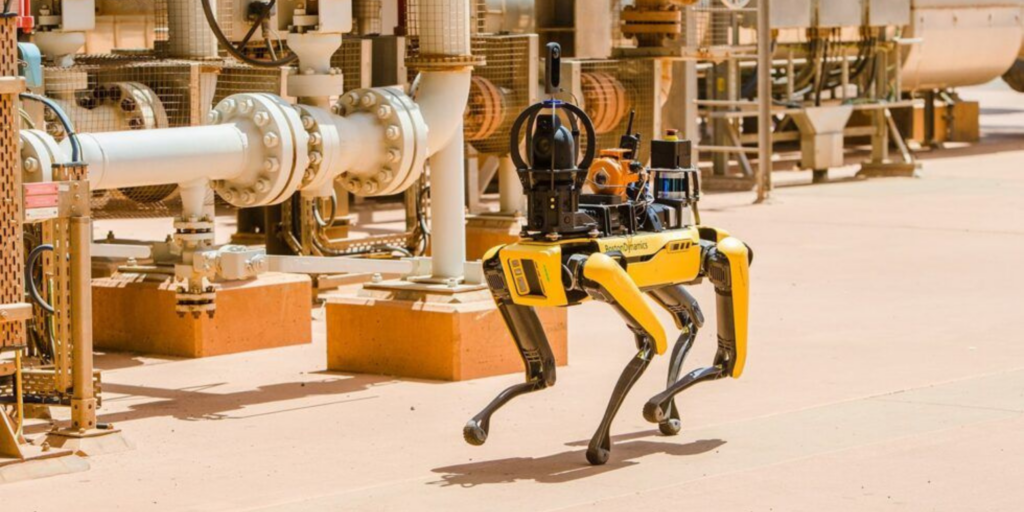
Nicknamed “Spector”, the program uses Boston Dynamics’ Spot robot to conduct routine inspections at Pluto LNG, a major liquefied natural gas facility in northwestern Australia.
The Pluto LNG facility is a towering maze of pipes, platforms, and machinery located on a remote stretch of coastline in northwestern Australia, over 1000 km from the nearest city. Operated by Woodside Energy—Australia’s largest listed natural gas producer—the facility is one of the most technologically advanced LNG production facilities in the world, with capacity to produce 4.9 million tons of LNG each year from two offshore gas fields.
Headquartered in Perth, Woodside has oil, gas, and new energy projects stretching from Australia to the Gulf of Mexico. Site preparation of Pluto LNG began in 2007 and took seven years to complete. Woodside plays a crucial role in providing energy to customers in Australia and globally, so running a safe and efficient facility is paramount.
Spector is able to go and find information. [T]hen we’re able to access that information, run analytics on top of that. So it provides the operator with a detailed view of what they need to do next.
Shawn Fernando, PROC Delivery Manager
Using Robots for Risky Inspections
Given the scale of operations at Pluto LNG as well as the site’s critical nature to the region, it’s important to avoid issues that may result in downtime. This means identifying issues early and often, before they escalate into hazardous situations. Enter Boston Dynamics’ agile mobile robot, Spot.
[Lire aussi : What Is the Hierarchy of Control?]
Woodside recently launched a new data capture service at Pluto LNG featuring the robot, which Woodside calls “Spector,” conducting routine inspections throughout the site and therefore reducing the exposure of operators to potential hazards. Woodside is using the first set of Spector-captured images to complete regulatory visual inspections for electrical equipment under Woodside’s performance standards.
Woodside worked closely with Boston Dynamics and DroneDeploy, which provided Spector’s linkage between Spot and Woodside’s in-house digital twin of the Pluto LNG facility, known as “FUSE”. The agile mobile robot moves autonomously through the facility, navigating obstacles and righting itself in case of stumbles.
“Drone Deploy’s advanced robotic inspection platform enables Woodside to programmatically send robots to inspect critical assets,” said David Inggs, Head of Robotics & Automation at DroneDeploy. “This significantly reduces the time inspectors need to spend in hazardous environments.”
Multiple Cameras Onboard
Spot’s payloads include Spot CAM+IR, which features a 30x optical zoom camera and a thermal camera that can detect whether equipment is at risk of overheating. The goal is to confirm equipment is in good operating condition, as well as identify potential problems before they can escalate.
To operate the robot in classified hazardous locations in accordance with legal requirements and Woodside’s risk assessment procedures and policies, a custom safety payload was developed and implemented. If Spot senses gas while conducting an inspection or gas elsewhere on site, the safety payload will immediately shut down the robot by electrically isolating the battery.
By completing this hazardous and routine work, Spector allows humans to focus on what they do best—assess and solve problems.
“Spector is able to go and find information,” said Shawn Fernando, PROC Delivery Manager. “[T]hen we’re able to access that information, run analytics on top of that. So it provides the operator with a detailed view of what they need to do next.”
Giving Crews Greater Awareness
Spector transmits images and data directly into Woodside’s digital twin, FUSE, so operators and analysts can pinpoint the exact location of an issue within a virtual environment.
Before the Spector program, it could take up to 90 minutes to find equipment and then complete an end-to-end visual inspection of that equipment. With Spector, inspectors can review images first to determine their response and bring exactly what they need.
“One of the biggest benefits of the robot-captured images is that they can be used to identify issues before arriving in the field,” said Bruce Hill, Electrical Inspection Coordinator at Woodside. “This means we can bring spares and fix any issues as soon as possible, saving even more time.”
Additional Payloads Available
Although the Spector program currently focuses on visual and thermal inspections, future payloads could enable Spector to report leaks and noise anomalies, perform line of fire tasks in high-voltage substations, and build a continuously updated 360° view for planning work scopes and identifying changes in the asset condition over time.
Looking to the future, Hill added, “We build learned image recognition of defects and early reporting in a continuous supervision capacity, allowing other teams to be notified when there might be an issue.”
How Woodside got started with Spot and their initial pilot process
Woodside, the largest Australian natural gas producer, has three top priorities at its processing facilities: safety, reliability, and efficiency – in that order.
Gas processing plants are complex, potentially hazardous sites, with an array of equipment that needs to be continuously monitored and inspected. Woodside has made proactive investments in Internet of Things (IoT) technologies, but has found it impractical and cost-prohibitive to cover every inch of their sprawling onshore plants with smart sensors. Wheeled robots are appropriate for limited inspection use cases, but they have difficulty operating on uneven terrain and move too slowly to be effective across large distances.
Enter Spot.
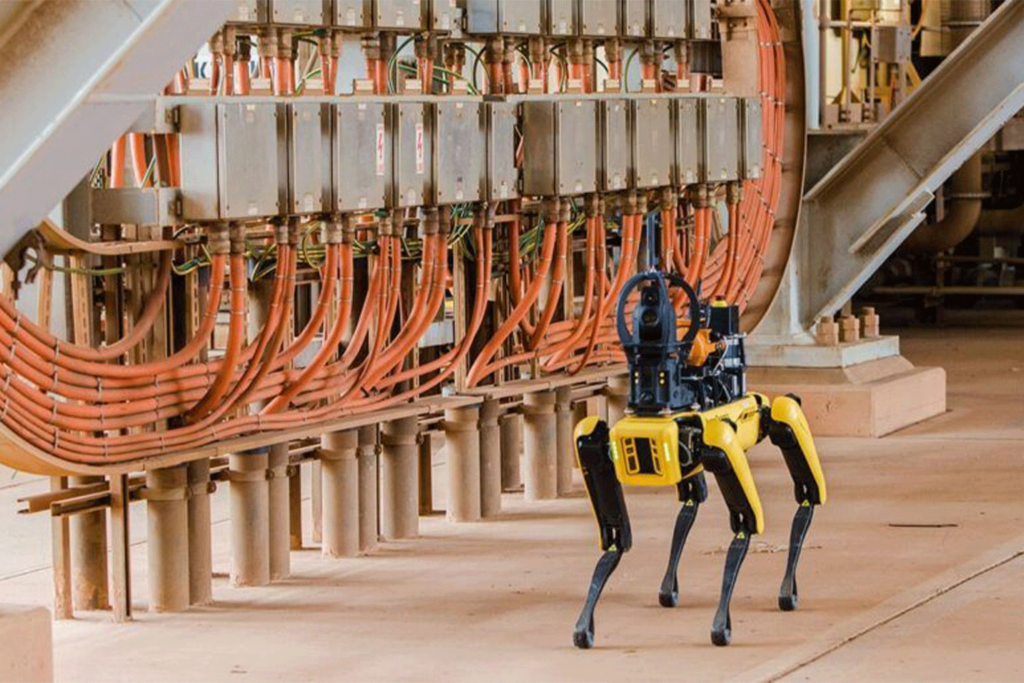
Woodside is still testing the agile mobile robot from Boston Dynamics. But the company believes that Spot has the potential to handle a diverse range of inspection tasks across its facilities – ultimately helping Woodside to improve safety, reliability and efficiency of its operations. Spot is one aspect of Woodside’s broader intelligent asset workstream, where the company is hoping predictive maintenance could significantly reduce its annual maintenance bill.
Safety First
With safety a top priority at its plants, Woodside is taking a close look at how to use Spot to take on higher-risk tasks and keep employees as safe as possible. “Some activities are higher risk than others,” says Tim Byrne, a surveillance engineer at Woodside. “We’re always looking for ways to make people safer and eliminate risk.”
For instance, it would reduce risk and be more efficient if it were possible to use Spot for inspections in areas with high-voltage transformers. Similarly, Byrne anticipates that Spot could be sent in as a “first responder” during emergency situations, collecting visual information to help prepare human response teams. Also, Byrne says, Spot is an ideal fit for inspecting sites during periodic shutdowns.
“You can only observe the performance of some equipment when it’s going through that transition state from on to off,” Byrne explains. “When the plant’s running stable, it’s quite safe. When we shut down a plant, it’s dynamic. It’s still safe, but it’s a higher risk activity. So, making use of Spot to do some of the surveillance would be great.”
Game-Changing Mobility
Mark Micire, the head of robotics at Woodside, says he joined the company partly because he considered its proposed use of Spot to be “leading edge,” and he wanted to be a part of that. “When I heard that Woodside was working with Boston Dynamics and had decided to deploy Spot robots, that really swayed my decision to come to Woodside,” he says.
For Woodside, Micire says, the most significant feature of Spot is the robot’s ability to navigate nearly any terrain. “The biggest value is Spot’s mobility,” he says. “The nature of its quadruped mobility is a huge benefit for the kinds of environments that we’re working in. Wheeled platforms can only really get us so far when we’re dealing with plants that have stairs and uneven terrain, so that’s a huge, huge value.” While tracks can improve robots’ stability, Micire notes, they perform poorly on surfaces such as gravel, and can quickly become fouled if they are exposed to moisture and dirt.
Other robotics platforms also struggle to simply keep up with the size of Woodside’s sites. “The speed with which the Spot can move, as opposed to the wheeled platforms, is much faster,” says Byrne. “One of the ways you make operations safer is by separating equipment out over a wide area. For an onshore plant, we’re spread out over a couple of kilometers, and our wheeled platforms are quite slow. So, for wheeled platforms to be effective, you need a lot more of them than you would with Spot. It’s not just about navigating terrain, but also just traversing from one part of the plant to the other.”
For Woodside, Spot demonstrated its potential during a 2020 site visit by Boston Dynamics. During that test, the company was impressed by both the ease with which Spot navigated their environment and by the user-friendliness of the platform. “I’m not a ‘video-game’ kind of person,” says Shreya Shree, a graduate surveillance engineer with Woodside. “When the Boston Dynamics team was here, it was easy to drive the robot all by myself, so I think it’s really user-friendly.”
Byrne acknowledges that he was something of a Boston Dynamics “fanboy,” even before the site visit. He says that Spot’s on-site performance lived up to the hype surrounding the robot’s famous viral videos. “When Woodside first started talking about robotics, we saw a video of Spot online, and I said, ‘that’s where we want to be,’” Byrne recalls. “Then, when the Boston Dynamics team came on-site with Spot, I was excited to see how easily it could go up rock piles, traverse split levels, and walk on concrete, asphalt, and gravel rock. It was actually quite impressive to see that.”
Spot did initially struggle to navigate one key feature of Woodside’s facilities – mesh metal stairs – but that limitation lasted only a few weeks. “To our delight, within a couple of months of the visit, Boston Dynamics was able to do a software update, and we were able to verify that it now allows Spot to deal with the grid mesh stairs that are pretty much prevalent all over our sites,” says Micire. “That is a capability that none of our other platforms have.”
Every 12 hours, we follow the same path through the plant, and we’re assessing situational awareness. Spot is going to capture things we may not notice or that we’re not always around to see.
Christopher Phillips, Production Technician, Woodside
Limitless Applications
Early on, Woodside and Boston Dynamics identified six potential applications for Spot: gauge reading, leak detection, noise anomaly detection, thermal inspection, gas detection, and remote inspection.
Currently, human operators have a set number of analog gauges to read and report on. As they make their rounds, human operators also look for water and steam leaks (which can degrade performance or result in risks to workers), inspecting the fittings and connectors between pipes that carry steam or liquids between various parts of the plant. Likewise, human workers keep an ear out for odd noises, use thermal cameras to inspect for potential hot spots, carry gas detectors with them, and manually inspect equipment when alarms go off. Woodside anticipates that Spot will be able to record and report all of this data using cameras, microphones or other peripherals, freeing up employees for other tasks.
Christopher Phillips, a Woodside production technician, says Spot will also help to cut down on the number of variables that arise as human workers make rounds on the facilities.
“Every 12 hours, we follow the same path through the plant, and we’re assessing situational awareness,” he says. “It’s important to communicate across shift changes and make sure you’re handing off critical information. Spot is going to capture things we may not notice or that we’re not always around to see.”
Byrne stresses that the company isn’t using Spot to replace human workers. Rather, he says, officials want to use Spot to make the plant as safe as possible, free up those employees from rote, mundane chores and give them more time for tasks that require human skill and create value for the company.
“With the current economic climate, it’s all about operating safely and getting the most from our people and then freeing them up to do the higher-level activities,” Byrne says. “Releasing them from the lower-value, mundane activities is where I see Spot really coming to the forefront. So, it’s not about using Spot to replace people. It’s about using Spot to keep our people away from hazards and free our people up for the high-value activities that really drive up performance on-site.”
Byrne calls tasks like gauge reading “a good stepping stone,” but he is ultimately excited by slightly more complex use cases. For instance, employees currently verify that specific systems – such as valves or electrical equipment – have been isolated before another worker makes a repair. “In emergency situations, where access may not be safe for a human, the team could deploy Spot to verify the isolation.
Byrne compares Spot to a smartphone. When the smartphone debuted in 2007, he notes, most people did not anticipate that they would one day rely on the device for tasks as varied as mobile banking, managing their grocery lists, and booking hotel rooms. Similarly, he says, he expects that Woodside and other companies will continue uncovering revolutionary new uses for Spot well into the future.
“The smartphone resulted in a whole bunch of apps that we didn’t know we needed, and that wouldn’t be possible without the tool,” Byrne says. “I think what Spot can bring to us is a new set of tools that will enable us to do things that we didn’t even think we could do before.”
Originally published by Boston Dynamics ici.
 English
  English (Canada)
  Français du Canada