
Ressources / Article / How MFE Gets Spot Ready for Remote Gas Detection
Article
How MFE Gets Spot Ready for Remote Gas Detection
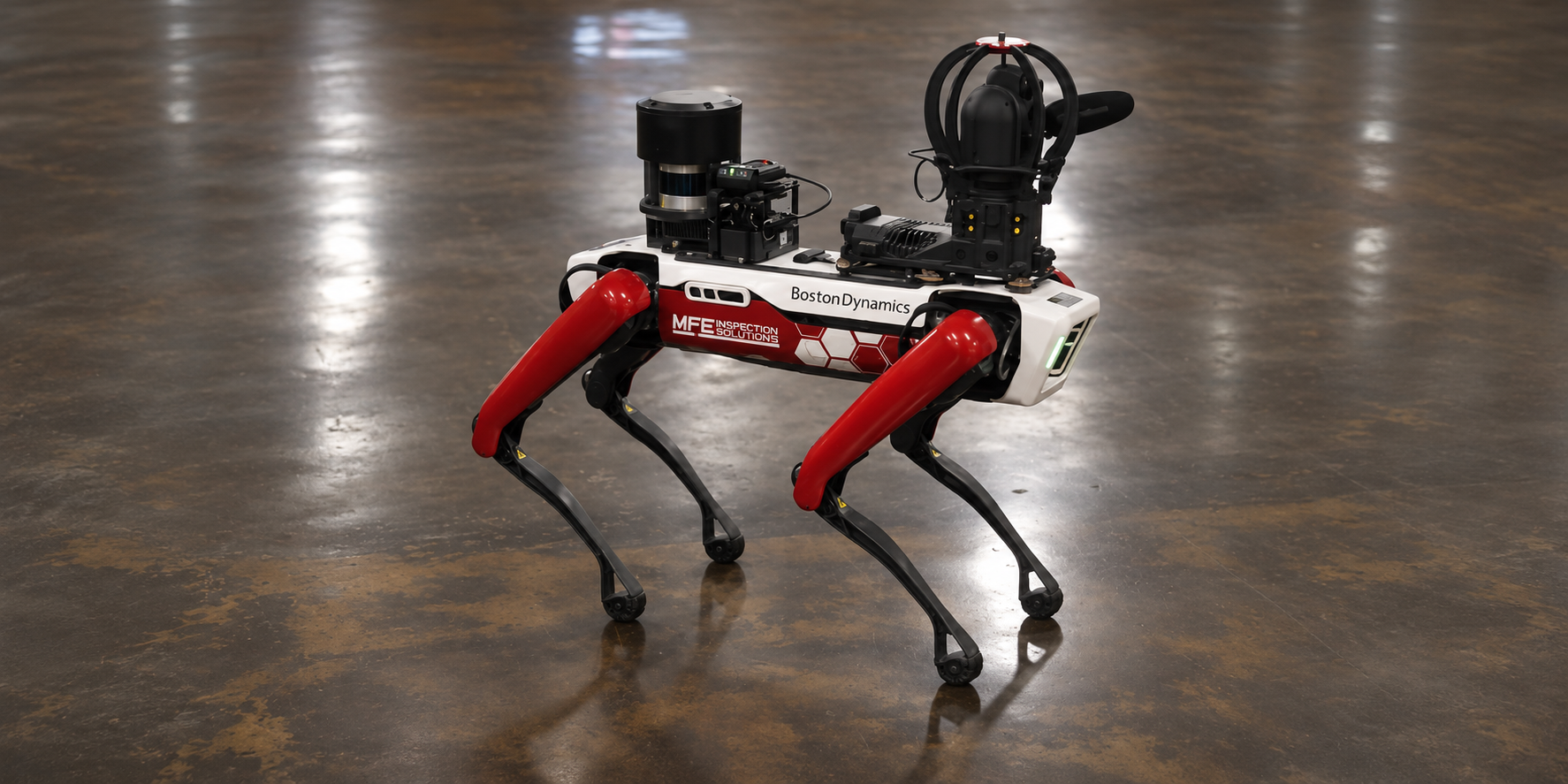
With MFE’s custom integration, Boston Dynamics’ Spot can now carry a Blackline Safety portable gas detector. This pairing lets teams collect gas readings remotely, improving safety for people on the jobsite. In this article, we go inside our Houston shop to share how we built, tested, and packed 37 kits for a recent shipment.
Is there gas in the area?
It’s a crucial safety question. But getting the answer can be dangerous, requiring personnel to enter a worksite with a portable gas detector—before they know if it’s safe to do so.
That’s why we built the Solution de détection de gaz connectée MFE Spot to improve safety by providing remote gas sensing.
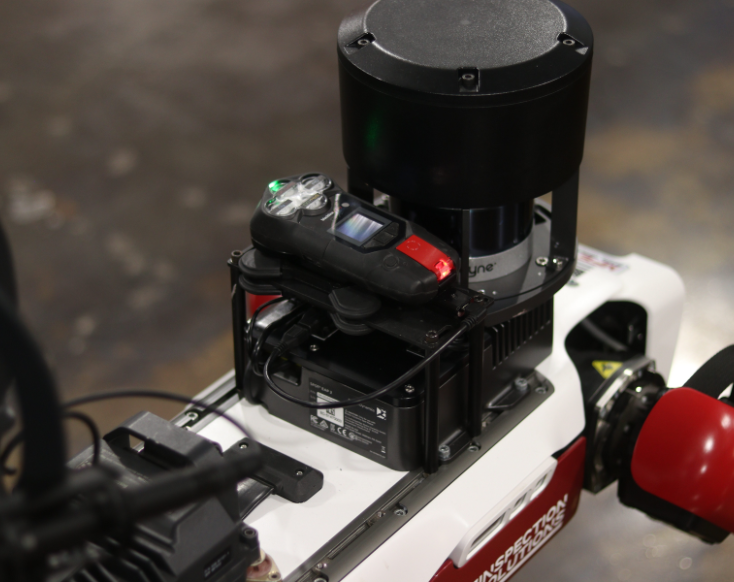
The kit integrates a cloud-connected Blackline Safety portable gas detector with the Boston Dynamics Spot robot.
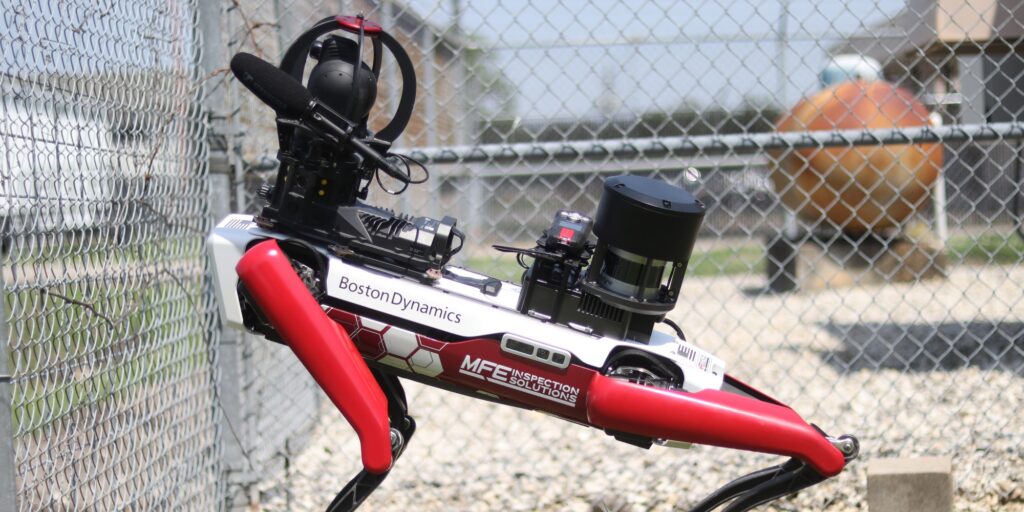
If you already use Spot for inspections, the kit lets you collect gas readings along the same route.
We launched the integration in June of this year. So far we’ve sold about 60 kits, all ordered through Boston Dynamics.
Orders have come from semiconductor, solar, metals, and oil and gas companies. And recently, we filled our biggest order yet—37 kits, all built, tested, and shipped at the same time.
Here’s how teams use the integration and how we build and test each kit.
What Changes When Spot Can Collect Gas Readings?
Spot can give an operator a remote view of a pump and the equipment around it.
With the Blackline Safety detector onboard, the robot can also collect gas readings along the route, before anyone approaches the pump.
This is a big safety improvement.
Without this capability, the main option for gathering that data would be to send in a person wearing a gas detector, potentially exposing them to harmful gases.
Gas readings can also inform what Spot does during a mission. For example, teams can configure the robot to return to base when a defined gas threshold is reached.
And the gas data isn’t limited to the person operating Spot.
While the operator can see gas readings and alerts on the controller, colleagues following remotely can view them in Blackline Live where cellular coverage is available.
| Who’s looking | What they can see |
|---|---|
| The Spot operator | Gas readings and alerts on the Spot controller during the inspection. |
| A remote safety or operations team | With cellular coverage, readings and alerts in Blackline Live alongside data from connected personal and area monitors. |
How We Build the Hardware that Mounts the Gas Detector on Spot
We recently filled a 37-kit order placed through Boston Dynamics.
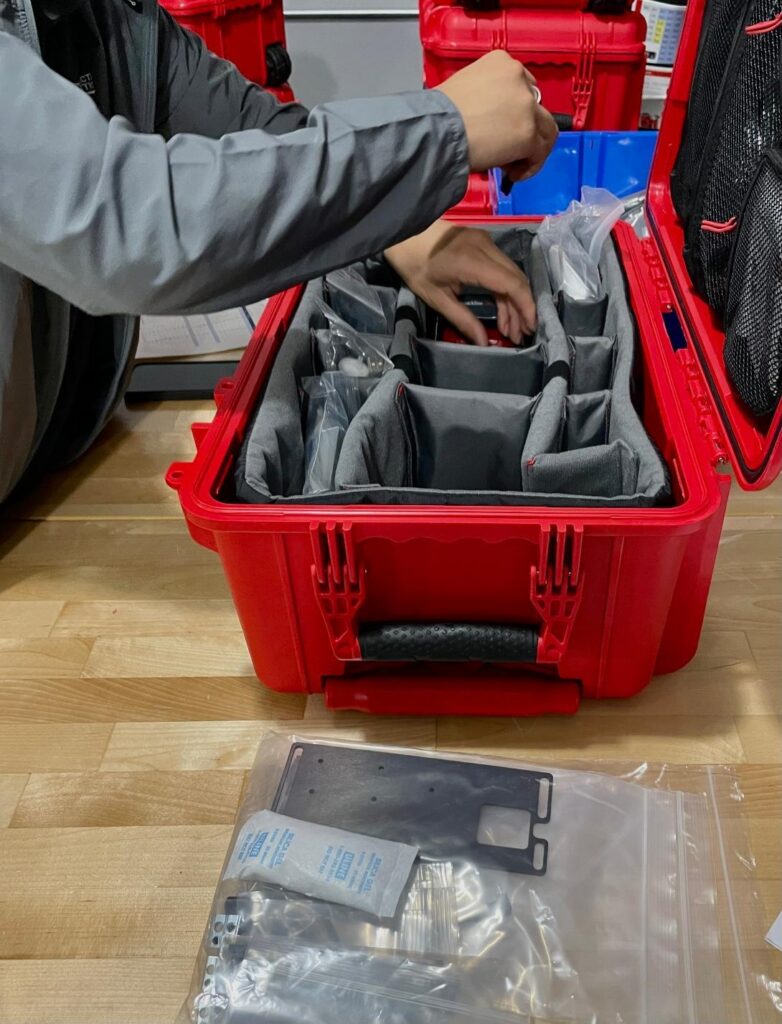
As we built them out on our Houston shop floor, we had rows of red cases lining the worktables.
The cases are fairly small. And the work inside each one starts with a much smaller piece of hardware: the plate that holds the detector on the robot.
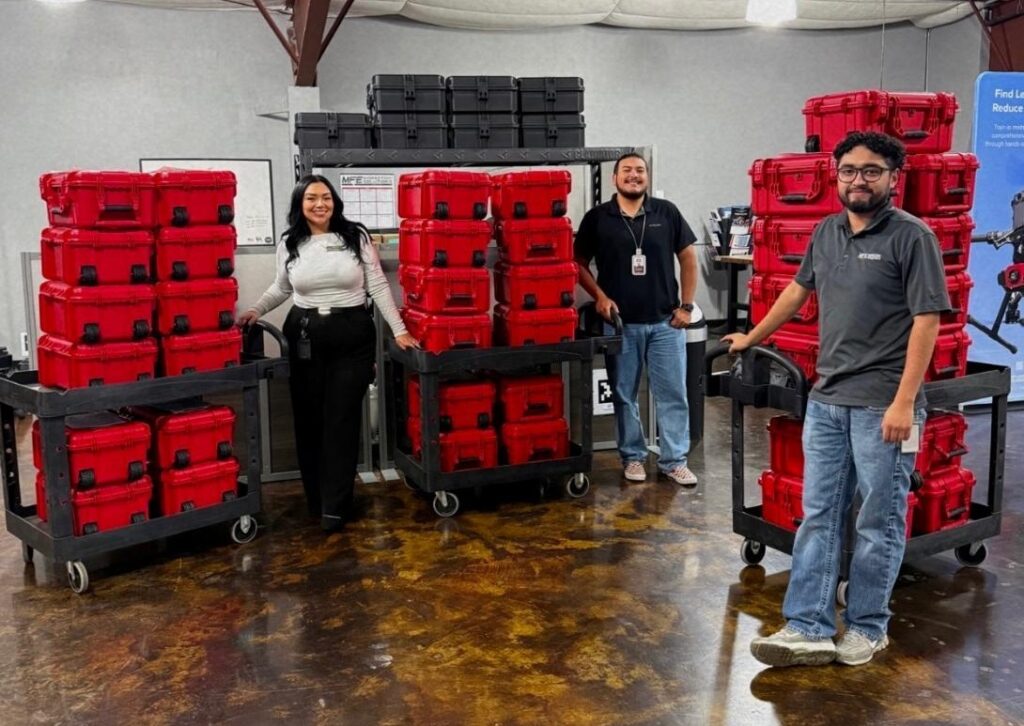
To build a single kit, our team in Houston:
- Makes the custom mounting plates and spacers,
- Sources the remaining hardware, and
- Organizes the components for each kit
The detector itself can also be configured around what a facility needs to monitor.
Recently, a large solar panel manufacturer in the Southeast needed to detect hydrogen fluoride and ammonia, so we worked with Blackline Safety to build a custom sensor cartridge for that application.
As the batch moves through the shop, the crew has to keep track of what goes into each case, and which kits are ready for testing.
One change makes setup easier at the customer’s end: the current kit uses a single-cable connection in place of the earlier terminal plugs.
It’s a small detail on the workbench, and it simplifies the connection the customer makes when setting up the payload.
Testing Every Kit
Every kit goes through an end-to-end test using MFE’s Spot, the Spot controller, and Boston Dynamics’ Orbit software.
That brings the hardware and software together on the robot before the kit goes into its case.
After testing, the Houston team:
- Checks the serial numbers three times against the quality-control sheets.
- Labels and boxes each kit, accounting for the components that go with it.
For every unit, the Houston crew assembled, triple-checked, and palletized all 37 kits in one push.
What Happens after the Kit Arrives?
The customer registers the units after receiving them. Then MFE issues the license and links the units to Blackline Live.
That’s the step that brings remote monitoring online as part of customer setup.
After the kit is online, customers can view and share their Spot-collected gas data in Blackline Live. The software also lets them view connected personal and area monitors, providing live visibility into changing conditions across the worksite.
All this data means more knowledge of where gas hazards are located—and that means a safer workspace for everyone.
Learn more about the Solution de détection de gaz connectée MFE Spot.
 English
 English (Canada)
 Français du Canada