
Guide
Intrinsically Safe: What It Means, Ratings, and How to Choose Equipment
Last updated: November 2026 · By Zacc Dukowitz
“Intrinsically safe” describes electrical equipment that is designed and approved so it can’t release enough electrical or thermal energy to ignite the flammable gas, vapor, or combustible dust around it, even when certain faults occur. It is one of the ways OSHA permits electrical equipment to be used in hazardous (classified) locations.
An intrinsically safe rating isn’t a blanket approval. Each rating covers specific hazardous locations, gas or dust groups, and temperature classes. Before you buy or rent an inspection tool, check that its label and certificate match the area where you will use it.
This guide is for inspection service providers and facility teams in oil and gas, refining, chemical processing, utilities, mining, and other operations with hazardous locations. It covers what the term means, how intrinsic safety works, how it differs from explosion-proof protection, how U.S. hazardous locations are classified, how to read an intrinsically safe marking, and what to check before a tool goes into a classified area.
In this guide
- What “intrinsically safe” means
- How intrinsic safety works
- Intrinsically safe vs. explosion-proof
- Hazardous location classification in the U.S.
- How to read an intrinsically safe rating
- Device approval vs. system approval
- Intrinsically safe certification
- How to check that a tool matches your area
- Common misconceptions
- Intrinsically safe inspection equipment from MFE
- FAQ
- Standards and sources
What does “intrinsically safe” mean?
Intrinsically safe equipment can’t ignite a flammable atmosphere because its circuits are limited to energy levels too low to cause ignition by a spark or by heat. That limit holds in normal operation and under the fault conditions its standard defines. The international standard for the technique, IEC 60079-11, describes intrinsic safety (“i”) as a type of protection that restricts electrical energy, within the equipment and in any wiring exposed to the explosive atmosphere, to below the level that can cause ignition by sparking or heating.
The two terms are often used interchangeably, but they mean slightly different things. Intrinsic safety is the protection technique. Intrinsically safe describes equipment that has been evaluated and approved under that technique for particular hazardous locations. A product described as “intrinsically safe” is only as useful as the approval behind it.
What intrinsically safe means in U.S. workplaces
OSHA’s electrical standard for hazardous (classified) locations, 29 CFR 1910.307, requires equipment, wiring methods, and installations in those locations to meet one of three conditions:
- intrinsically safe
- approved for the hazardous (classified) location
- safe for the hazardous (classified) location
Under the first option, equipment and associated wiring approved as intrinsically safe are permitted in any hazardous (classified) location for which they are approved.
The phrase “for which it is approved” matters. OSHA’s definitions in 29 CFR 1910.399 tie “approved” to equipment that is accepted, certified, listed, labeled, or otherwise determined safe by a nationally recognized testing laboratory (NRTL), among other routes. An intrinsically safe approval therefore applies only to the locations, gas or dust groups, and temperature classes shown on the equipment’s label and certificate, not to every hazardous area on a site.
Where intrinsically safe equipment is used
Intrinsically safe equipment is used where flammable gases, vapors, or liquids, or combustible dusts or fibers, may be present in ignitable amounts. OSHA names occupancies where hazardous (classified) locations may be found, including:
- petroleum and chemical processing plants
- bulk storage plants for gasoline and other volatile flammable liquids
- paint-finishing process plants
- agricultural or other facilities where excessive combustible dust may be present
OSHA also requires each room, section, or area to be classified on its own, so one facility can contain several classifications, and a single inspection route can cross more than one of them.
Intrinsically safe apparatus vs. associated apparatus
IEC 60079-11 separates two kinds of equipment:
- Intrinsically safe apparatus is equipment in which all circuits are intrinsically safe, such as a battery-powered handheld instrument built entirely to the standard.
- Associated apparatus contains both intrinsically safe and non-intrinsically safe circuits. A typical example is a barrier or isolator that powers a field instrument from outside the hazardous area.
This distinction decides whether you are checking one device or a whole loop. It is covered in device approval vs. system approval.
How does intrinsic safety work?
Intrinsic safety keeps the energy in a circuit too low to ignite the surrounding atmosphere, instead of keeping the atmosphere away from the circuit. Electrical equipment can ignite a flammable gas, vapor, or dust in two ways:
- a spark when a circuit opens, closes, or shorts
- a hot surface
An intrinsically safe design is assessed against both.
Spark energy and surface temperature
For sparks, IEC 60079-11 requires the circuit to be assessed or tested for spark energy at every point where an interruption or interconnection may occur. That includes opening, shorting, and earthing the external connection points. Energy stored in the circuit also counts. That is why intrinsically safe documentation lists capacitance and inductance values alongside voltage, current, and power limits.
For heat, every surface that can contact the explosive atmosphere is assessed for its maximum temperature under the same fault conditions. This covers components, enclosures, wiring, and circuit-board tracks. The result appears on the label as the temperature class (T-class), explained in how to read an intrinsically safe rating.
Because the energy has to stay below ignition levels, intrinsic safety only works for low-power circuits. It fits instruments and sensors. Equipment that needs more power relies on other protection methods, compared in intrinsically safe vs. explosion-proof.
Batteries, charging connections, and data ports are part of the evaluation too. IEC 60079-11 has separate requirements for:
- batteries that are replaced inside an explosive atmosphere
- batteries that are used there but not replaced there
- connection facilities, such as charging connections, intended for use only in a non-hazardous area
Whether you can swap a battery, charge, or connect a cable in the field depends on the equipment’s certificate and the manufacturer’s instructions, not simply on the fact that the tool is intrinsically safe.
Levels of protection: ia, ib, and ic
The level of protection tells you how many faults an intrinsically safe circuit can tolerate and still not cause ignition. IEC 60079-11 places intrinsically safe apparatus in three levels.
| Level | Must not cause ignition… | Equipment protection level (EPL) it is typically marked with | Gas zone that EPL is for |
|---|---|---|---|
| ia | in normal operation, with one countable fault, and with two countable faults, each combined with the non-countable faults that create the worst-case condition | Ga | Zone 0 |
| ib | in normal operation and with one countable fault, each combined with the non-countable faults that create the worst-case condition | Gb | Zone 1 |
| ic | in normal operation, under the conditions the standard specifies; it does not carry the one- or two-fault tolerance required of ib and ia | Gc | Zone 2 |
In the standard’s terms, a countable fault occurs in a part built to its construction requirements, and a non-countable fault occurs in a part that isn’t.
Two cautions apply when you compare tools:
- Read the whole marking, not just “ia.” Certified markings can combine protection types and levels, so the EPL at the end of the marking is what tells you which zone the equipment suits.
- “Ex ic” equipment is a Zone 2 tool. Under the IEC and ATEX zone schemes, level ic is suitable for Zone 2 (and Zone 22 for dust), not for Zone 0 or Zone 1. If the area is Zone 0 or Zone 1, an ic rating doesn’t fit.
Levels ia, ib, and ic belong to the zone-style “Ex” and “AEx” markings. Equipment approved under the U.S. Class/Division system is marked with its class, division, groups, and temperature code instead. How the two systems relate is covered in hazardous location classification in the U.S.
Intrinsically safe vs. explosion-proof: what’s the difference?
Intrinsically safe equipment prevents ignition by keeping its energy too low to ignite the atmosphere. Explosion-proof equipment allows ignition inside a strong enclosure and stops it from reaching the atmosphere outside. OSHA defines explosion-proof apparatus as equipment enclosed in a case that meets three conditions:
- it can withstand an explosion of a specified gas or vapor inside it
- it prevents that internal explosion from igniting the gas or vapor around the enclosure
- it operates at an external temperature that won’t ignite the surrounding atmosphere
One method prevents the ignition source from forming. The other contains it.
That difference changes what keeps each method working. An intrinsically safe tool depends on its assessed circuits staying within their limits. Explosion-proof protection depends on the enclosure and its wiring connections staying intact. OSHA, for example, requires threaded conduit to be made wrench-tight in zone-classified areas partly to protect the explosionproof or flameproof integrity of the conduit system.
| Intrinsically safe | Explosion-proof | |
|---|---|---|
| How it protects | Limits electrical and thermal energy below the level that can cause ignition | Contains an internal explosion and prevents it from igniting the outside atmosphere |
| What it relies on | Circuit design assessed for sparks and surface temperature, under defined fault conditions | Enclosure strength, joints, and wiring connections staying intact |
| Power | Limited to low-power circuits | Doesn’t rely on limiting circuit energy |
| Where OSHA permits it: Division system | Any hazardous (classified) location for which it is approved | Class I, Division 1 and 2 locations for which it is approved |
| Where OSHA permits it: Zone system | Class I, Zone 0 or Zone 1 locations for which it is approved | The zone-system counterpart, flameproof “d,” is permitted in Class I, Zone 1 locations for which it is approved |
Two points in that table are easy to miss:
- Zone 0. Of the protection techniques OSHA lists for the zone system, intrinsic safety is the only one permitted in Zone 0. Not every intrinsically safe tool qualifies, though. Only the ia level of protection, marked for EPL Ga, is intended for Zone 0 (see levels of protection).
- Terminology. “Explosionproof” is the Division-system term in OSHA’s standard. “Flameproof ‘d’” is the zone-system technique. They work on the same containment principle, but they are separate markings, so check the one your area’s classification calls for.
For a portable inspection tool, the deciding question is the same whichever method it uses. Does its approval cover your area’s class and division or zone, its gas or dust group, and its temperature class? The steps are in how to check that a tool matches your area.
Where non-incendive and other protection methods fit
Intrinsic safety and explosion-proof enclosures aren’t the only accepted methods. OSHA lists several other protection techniques, and most of them are limited to areas where an ignitable atmosphere is less likely. Non-incendive circuits, equipment, and components, for example, are permitted in Class I, Division 2; Class II, Division 2; and Class III, Division 1 or 2. They are not permitted in Class I, Division 1. A non-incendive rating is not an intrinsically safe rating, even though both are common on low-power equipment.
| Protection technique (as named by OSHA) | Where OSHA permits it, for equipment approved for that location |
|---|---|
| Intrinsic safety | Any location for which approved (Division system); Class I, Zone 0 or Zone 1 (Zone system) |
| Explosionproof apparatus | Class I, Division 1 and 2 |
| Flameproof “d” | Class I, Zone 1 |
| Purged and pressurized | Any hazardous (classified) location (Division system); Class I, Zone 1 or Zone 2 (Zone system) |
| Nonincendive circuit, equipment, or component | Class I, Division 2; Class II, Division 2; Class III, Division 1 or 2 |
| Dust-ignitionproof | Class II, Division 1 and 2 |
| Dust-tight | Class II, Division 2 and Class III |
| Hermetically sealed | Class I, Division 2; Class II, Division 2; Class III, Division 1 or 2 |
| Increased safety “e,” encapsulation “m,” oil immersion “o,” powder filling “q” | Class I, Zone 1 |
| Type of protection “n” | Class I, Zone 2 |
OSHA also accepts other protection techniques that meet its general requirement: equipment must be intrinsically safe, approved for the location, or safe for the location. In Division 2 locations, it allows general-purpose equipment when the employer can demonstrate that the equipment is not a source of ignition under normal operating conditions. These are decisions for the site and the authority having jurisdiction, not for the equipment label alone.
How are hazardous locations classified in the U.S.?
U.S. hazardous (classified) locations are described by the kind of material present and how likely it is to reach ignitable amounts. The class names the material:
- Class I: flammable gases or vapors
- Class II: combustible dust
- Class III: easily ignitable fibers or flyings
The likelihood is expressed as Division 1 or 2, or, for Class I only, as Zone 0, 1, or 2.
Under OSHA, a Class I installation can be classified with either the Division system or the Zone system. Class II and Class III locations must use the Division system. In the National Electrical Code (NFPA 70), the Class and Division system is covered in Article 500, and the Class I Zone system in Article 505.
Equipment buyers don’t classify areas, but they need the result. OSHA requires that areas classified under the Zone system, and areas classified under the Division system after August 13, 2007, be documented. That documentation must be available to the people authorized to design, install, inspect, maintain, or operate electric equipment there. OSHA also requires zone classification and the related equipment selection to be supervised by a qualified registered professional engineer. Before you specify an intrinsically safe tool, ask the site for the classification of every area the work will enter.
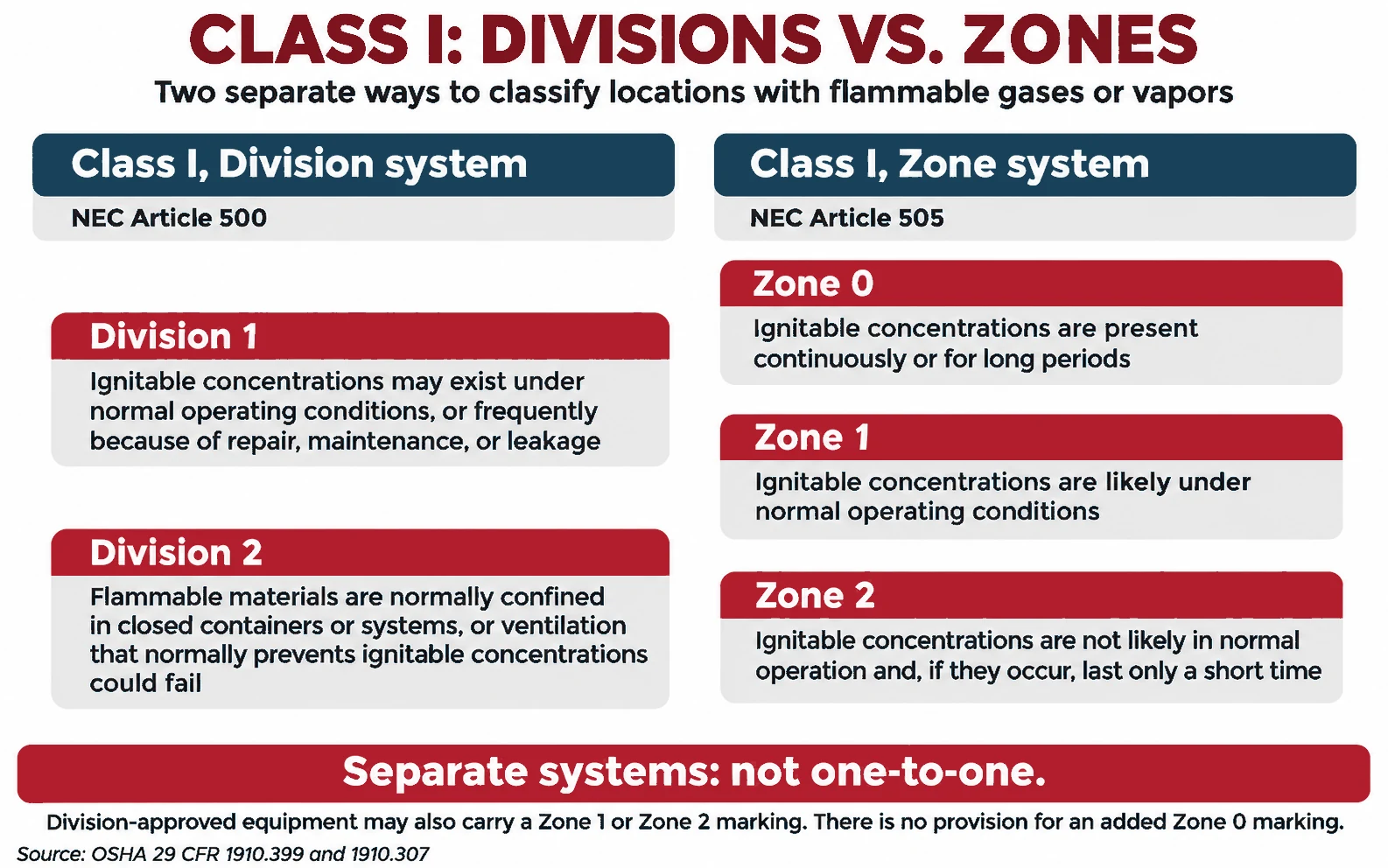
Class I, Division 1 and Division 2
Class I, Division 1 covers locations where any of the following applies:
- ignitable concentrations of flammable gases or vapors may exist under normal operating conditions
- they may exist frequently because of repair, maintenance, or leakage
- a breakdown or faulty operation could both release them and cause electric equipment to fail at the same time
Class I, Division 2 covers locations where any of the following applies:
- flammable liquids, gases, or vapors are handled but normally stay confined in closed containers or systems, escaping only through accidental rupture, breakdown, or abnormal operation
- positive mechanical ventilation normally prevents ignitable concentrations, but the ventilation could fail
- the area is next to a Division 1 location and could occasionally receive gases or vapors, unless adequate positive-pressure ventilation with safeguards prevents it
Equipment approved for a Division 1 location may be installed in a Division 2 location of the same class and group. The reverse does not hold.
Area classification tells you which equipment approvals are required. It doesn’t measure the atmosphere during the work. For that side of the job, see our guide to combustible gas and LEL monitoring.
Class I, Zone 0, Zone 1, and Zone 2
- Zone 0: ignitable concentrations of flammable gases or vapors are present continuously or for long periods.
- Zone 1: any of the following applies:
- ignitable concentrations are likely under normal operating conditions
- they may exist frequently because of repair, maintenance, or leakage
- equipment breakdown could both release them and make electric equipment an ignition source
- the area is next to a Zone 0 location without adequate positive-pressure ventilation and safeguards
- Zone 2: any of the following applies:
- ignitable concentrations are not likely in normal operation and, if they occur, last only a short time
- flammable materials are normally confined in closed containers or systems
- ventilation that normally prevents ignitable concentrations could fail
- the area is next to a Zone 1 location without adequate positive-pressure ventilation and safeguards
Zone ratings work downward. Equipment listed for Zone 0 may be installed in Zone 1 or Zone 2 for the same gas or vapor. Equipment listed for Zone 1 may be installed in Zone 2.
Why Divisions and Zones don’t map one-to-one
The Division and Zone systems are separate ways of classifying Class I locations, so a rating in one doesn’t automatically translate into the other. The Division system has two levels and the Zone system has three, so there is no Division level that corresponds only to Zone 0. OSHA’s rules keep the two systems apart in three ways:
- Where the systems meet on a site. A Zone 2 location may abut, but not overlap, a Division 2 location. Zone 0 and Zone 1 locations may not abut Division 1 or Division 2 locations at all.
- Reclassifying an area. A Division location may be reclassified as a Zone location only if all of the space classified because of a single gas or vapor source is reclassified.
- Added zone markings. Equipment approved for Class I, Division 1 or Division 2 may also carry a Class I, Zone 1 or Zone 2 marking, with its gas groups and temperature class. That rule makes no provision for an added Zone 0 marking.
In practice, a Class I, Division 1 approval doesn’t by itself show that a tool suits Zone 0. If the area is Zone 0, look for a Zone 0 marking, or an EPL Ga marking under the IEC and ATEX schemes, on the label and certificate.
Dust needs the same care. OSHA uses only the Division system for Class II and Class III locations. IEC and ATEX schemes use Zones 20, 21, and 22 for dust. A tool approved only for gases and vapors is not approved for combustible dust, so if your area is classified for dust, check that the label and certificate cover dust as well as gas.
How to read an intrinsically safe rating on a label
An intrinsically safe rating is a string of codes on the equipment label. Together they state where the equipment may be used:
- the type of hazardous location
- the protection method and level
- the gas or dust group
- the maximum surface temperature
U.S. equipment may carry a Class/Division marking, a Class/Zone (“AEx”) marking, international “Ex” markings, or several of these on one label.
OSHA’s own example of a zone-system marking is Class I, Zone 0, AEx ia IIC T6:
- Class I, Zone 0: the area classification
- AEx: the symbol for equipment built to American specifications
- ia: the type of protection designation, here intrinsic safety at level ia
- IIC: the gas classification group
- T6: the temperature classification
OSHA’s marking order also exempts intrinsically safe apparatus from showing the class, zone, and temperature classification. An IS label may therefore leave out fields you would see on other equipment, and the certificate fills in the details.
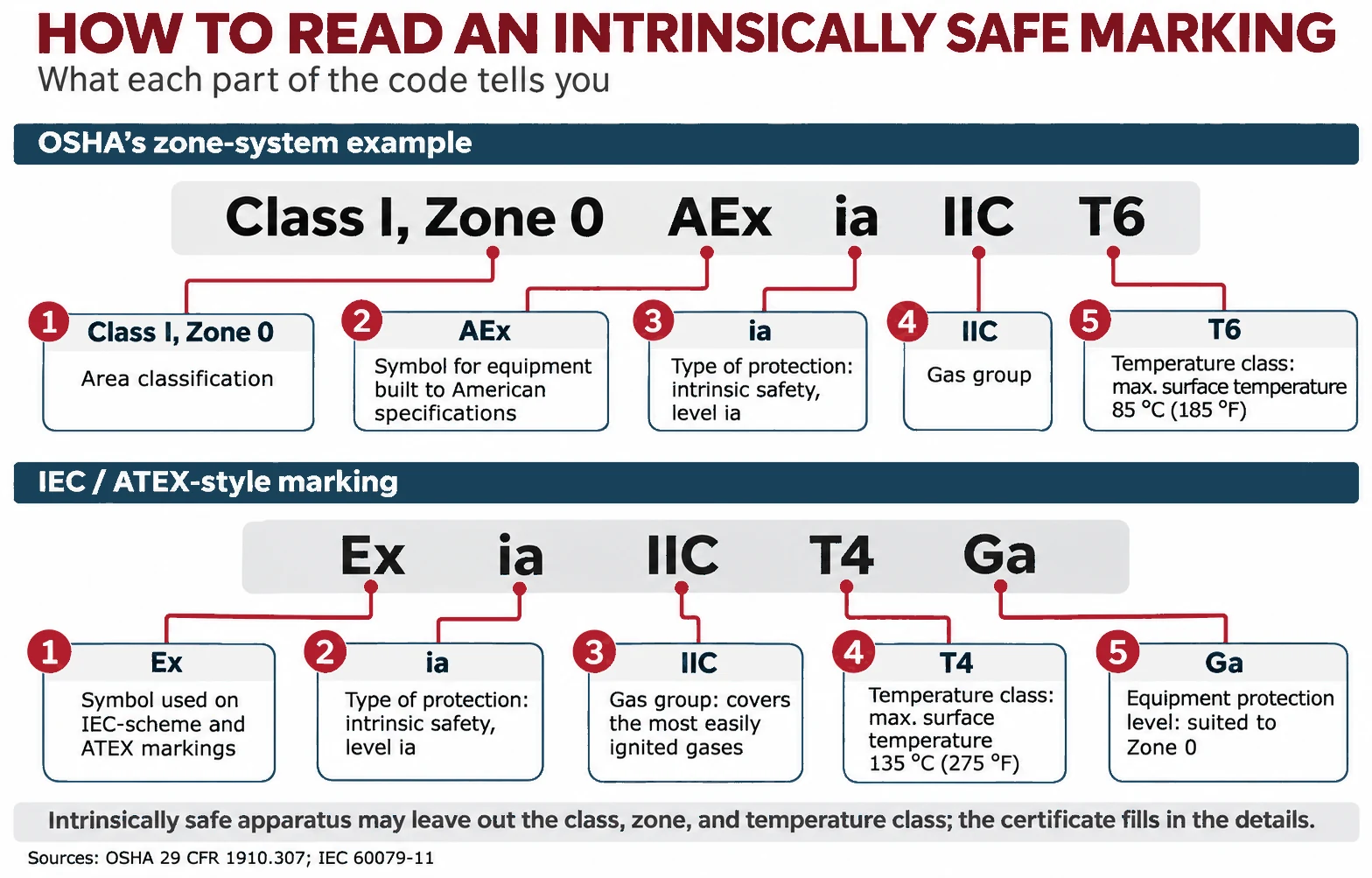
The parts of an intrinsically safe marking
| Part of the marking | Example | What it tells you |
|---|---|---|
| Class and division | Class I, Division 1 | The Division-system location type the approval covers. Division 1 approval also covers Division 2 of the same class and group. |
| Class and zone | Class I, Zone 0 | The Zone-system location type. Zone 0 listing also covers Zones 1 and 2 for the same gas or vapor. |
| Country or scheme symbol | AEx / Ex | AEx marks equipment built to American specifications. Ex appears on IEC-scheme and ATEX markings. |
| Type and level of protection | ia, ib, ic | Intrinsic safety and its fault tolerance (see levels of protection) |
| Gas or dust group | Groups A, B, C, D or IIC, IIB, IIA | The materials the approval covers (table below) |
| Temperature class | T4 | The maximum surface temperature (table below) |
| Equipment protection level (EPL) | Ga, Gb, Gc (gas); Da, Db, Dc (dust) | The zone the equipment is suited to under the IEC scheme: Ga for Zone 0, Gb for Zone 1, Gc for Zone 2 |
| ATEX group and category | II 1G | Group II (non-mining) equipment, Category 1, for gas atmospheres. Under the EU’s normal correspondence, Category 1G is for Zone 0, 2G for Zone 1, and 3G for Zone 2. |
Division-system markings follow a simpler pattern. OSHA requires equipment approved for a Class/Division location to be marked with the class, group, and operating temperature or temperature range. A Division label for an intrinsically safe tool therefore reads something like “Class I, Division 1, Groups A, B, C, D, T4.” Some labels also add the letters “I.S.”
Gas groups
The gas group tells you which flammable gases and vapors the approval covers. The Division system uses Groups A through D. The Zone and IEC systems use IIC, IIB, and IIA, listed in reverse alphabetical order of severity, so IIC covers the most easily ignited gases. Equipment marked for a more severe group is also suitable for the less severe ones. IIC equipment, for example, suits IIB and IIA applications.
| Zone/IEC group | Corresponding Division group(s) | Typical gas |
|---|---|---|
| IIC | Groups A and B | Hydrogen, acetylene |
| IIB | Group C | Ethylene |
| IIA | Group D | Propane |
Dust and mining have their own groups. In the IEC scheme, Group III covers combustible dusts and fibers, and Group I covers mines. A gas-only marking does not cover dust.
Temperature classes
The temperature class is the highest surface temperature the equipment can reach. It must be below the ignition temperature of the gases or vapors in your area. A higher T-number means a cooler surface. OSHA bases the marked temperature on a 40 °C ambient and does not allow the marking to exceed the ignition temperature of the specific gas or vapor present. Equipment rated for ambient temperatures above 40 °C must also be marked with that maximum ambient. Many labels show the permitted ambient range in a form such as “−20 °C ≤ Ta ≤ +50 °C.”
| Temperature class | Maximum surface temperature |
|---|---|
| T1 | 450 °C (842 °F) |
| T2 | 300 °C (572 °F) |
| T3 | 200 °C (392 °F) |
| T4 | 135 °C (275 °F) |
| T5 | 100 °C (212 °F) |
| T6 | 85 °C (185 °F) |
The Division system also uses intermediate codes such as T2A or T3C. If the gas with the lowest ignition temperature in your area calls for T2, equipment marked T2 through T6 is acceptable. Equipment marked T1 is not.
How to tell if a device is intrinsically safe
A device is intrinsically safe for your work only if its label and certificate show an intrinsically safe approval that covers your area’s classification, group, and temperature class. Words in a brochure or a product name aren’t enough. Check four things:
- The marking on the equipment. Look for an intrinsically safe marking on the device itself, such as “ia,” “ib,” or “ic” in an AEx or Ex string, or an intrinsically safe Class/Division marking.
- Who certified it. In the U.S., an NRTL that certifies a product authorizes the manufacturer to apply that NRTL’s registered certification mark. IECEx certificates can be searched online at iecex-certs.com. ATEX certificates are issued by notified bodies listed in the European Commission’s NANDO database.
- The certificate and instructions. A certificate number ending in “X” means the certificate lists specific conditions of use, such as precautions you must follow. Also read the instructions for limits on batteries, charging, and connections.
- The match to your area. Compare every field on the label with your area classification. See how to check that a tool matches your area.
Device approval vs. system approval: barriers, isolators, and entity parameters
A self-contained intrinsically safe instrument is certified as a piece of apparatus, so its own label and certificate are what you check. When an intrinsically safe field device is wired to equipment outside the hazardous area, the circuit is only intrinsically safe if the device, the wiring, and the equipment powering it are matched. OSHA’s rule reflects this. It permits equipment and associated wiring approved as intrinsically safe. IEC 60079-11 covers intrinsically safe apparatus and associated apparatus, and points to a separate standard, IEC 60079-25, for intrinsically safe systems.
For most portable inspection tools, the device level is what matters. A battery-powered handheld instrument whose circuits are all intrinsically safe has no field wiring back to a safe-area power supply, so its certificate covers its circuits. What can change that picture is anything you connect to it: a probe, cable, external sensor, charger, or data connection. Use only connections and accessories that the certificate or the manufacturer’s instructions permit, and only where they permit them.
For fixed instruments, the system level matters. A transmitter or sensor in a classified area that is powered and read by a controller in a safe area depends on associated apparatus between them. Associated apparatus is equipment containing both intrinsically safe and non-intrinsically safe circuits, built so the non-intrinsically safe side can’t affect the intrinsically safe side. On an IEC marking, square brackets identify associated apparatus, as in “[Ex ia Ga] IIC.” If associated apparatus is itself located in the explosive atmosphere, it needs protection by another method as well.
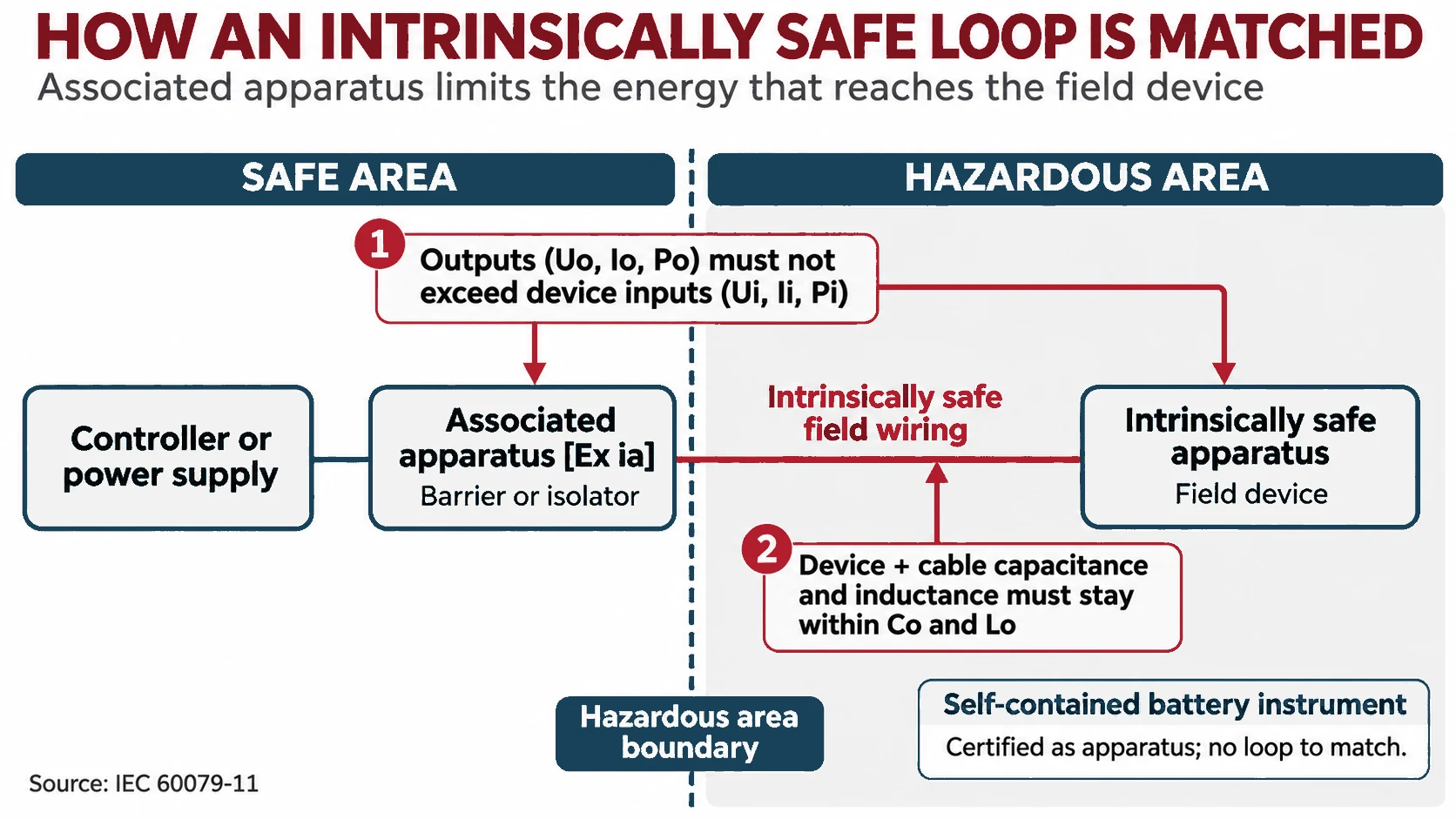
Entity parameters and control drawings
Entity parameters are the electrical limits that let a designer confirm whether a field device and its associated apparatus can be safely connected. IEC 60079-11 describes the entity concept as the method for determining acceptable combinations of intrinsically safe apparatus and associated apparatus, using intrinsically safe parameters assigned to their connection points. The parameters fall on two sides:
- The field device is rated with the maximum input voltage, current, and power it can accept (Ui, Ii, Pi). It also lists its internal capacitance and inductance (Ci, Li).
- The associated apparatus is rated with the maximum voltage, current, and power it can deliver (Uo, Io, Po). It also lists the maximum external capacitance and inductance that can be connected to it (Co, Lo).
North American documents may label the device-side values Vmax and Imax. The comparison confirms two things:
- the associated apparatus can’t deliver more than the device is rated to accept
- the capacitance and inductance of the device and its cable stay within what the associated apparatus allows
The manufacturer’s control drawing documents these parameters so the circuit can be installed correctly. Some passive parts don’t need their own intrinsically safe certification. IEC 60079-11 treats switches, junction boxes, resistors, and low-energy sources such as thermocouples and photocells as “simple apparatus,” provided they stay within limits the standard sets and comply with its other requirements. Designing and verifying these loops is work for the site’s qualified engineers; this guide covers what an equipment buyer needs to recognize.
How an intrinsically safe barrier works, and when it’s needed
An intrinsically safe barrier limits the energy that can pass from safe-area circuits into the hazardous area, even when something goes wrong on the safe-area side. IEC 60079-11 describes two common designs:
- A diode safety barrier uses shunt diodes or diode chains, including Zener diodes, protected by fuses or resistors, to limit voltage and current.
- A galvanic isolator transfers signal or power between two circuits without any direct electrical connection between them.
A barrier or isolator is needed when an intrinsically safe field device is connected to equipment outside the hazardous area that isn’t itself intrinsically safe. It doesn’t make an uncertified device intrinsically safe. Manufacturers’ control drawings for barriers specify what may be connected on the hazardous-area side: an approved device with suitable entity parameters, or simple apparatus. A self-contained battery-powered instrument doesn’t use a barrier. Its own certificate covers its circuits.
Intrinsically safe certification: who certifies equipment?
Intrinsically safe equipment is certified by independent certification bodies, not by OSHA, the IEC, or the seller. The certificate, and the mark on the label, come from the body that tested and assessed the equipment against a standard such as IEC 60079-11. The IEC itself states that it doesn’t attest conformity; independent certification bodies do. Which body’s certification you should look for depends on where the equipment will be used.
In the United States: NRTLs
OSHA treats equipment as approved for its electrical rules mainly through nationally recognized testing laboratories (NRTLs). Its definitions count equipment as acceptable when an NRTL has accepted, certified, listed, labeled, or otherwise determined it to be safe. OSHA allows narrower routes for equipment that no NRTL certifies and for custom-made equipment.
An NRTL is a private-sector organization that OSHA recognizes under 29 CFR 1910.7 to test and certify products to consensus-based standards. Each NRTL may certify only to the standards in its recognized scope. OSHA publishes those test standards as part of its NRTL program. After certifying a product, the NRTL authorizes the manufacturer to apply the NRTL’s registered certification mark. OSHA’s recognition of an NRTL is not an endorsement of the equipment that NRTL certifies.
Internationally: IECEx
IECEx is the IEC System for Certification to Standards Relating to Equipment for Use in Explosive Atmospheres. Under its Certified Equipment Scheme, manufacturers apply to an approved Ex certification body of their choice, and certificates are published in a single international online database. IECEx itself advises that if a certificate doesn’t appear in that database, it hasn’t been issued. That makes the IECEx certificate search a quick check when a label shows an IECEx certificate number.
In the European Union: ATEX
ATEX Directive 2014/34/EU covers equipment and protective systems intended for use in potentially explosive atmospheres. It sets the essential health and safety requirements and the conformity assessment procedures that apply before those products are placed on the EU market. The notified bodies that take part in ATEX conformity assessment are listed in the European Commission’s NANDO database.
A single label can carry markings from more than one system. For example, it might show a U.S. Class/Division line, an AEx line, and ATEX and IECEx certificate numbers together. Each marking is backed by its own certificate. OSHA’s definition of “approved” is written around NRTLs and the other routes above; it doesn’t name ATEX or IECEx. Whether equipment certified only under ATEX or IECEx is acceptable at a U.S. site is therefore a question for the site and the authority having jurisdiction.
ATEX vs. intrinsically safe: what’s the difference?
ATEX is a European legal framework for equipment used in explosive atmospheres. Intrinsic safety is one of the protection techniques such equipment can use. ATEX-certified equipment may be protected by intrinsic safety or by another technique, such as flameproof enclosures or pressurization. An ATEX marking alone doesn’t tell you a tool is intrinsically safe; look for “ia,” “ib,” or “ic” in the marking. Likewise, intrinsically safe equipment may hold NRTL, IECEx, or ATEX certification, or several of them, depending on the markets its manufacturer serves.
How to check that a tool matches your hazardous area
An intrinsically safe tool fits a job only when every field of its approval matches the classification of every area the work will enter. Start with the site’s area classification documentation, then compare it field by field with the tool’s label and certificate. If the tool carries more than one marking, use the marking that matches the system (Division or Zone) your site’s classification uses.
| Check | What your area requires | What the tool’s label and certificate must show |
|---|---|---|
| Material class | Class I (gases, vapors), Class II (dust), or Class III (fibers) | An approval for that class. For dust, a dust approval in addition to any gas approval. |
| Division | Class I, Division 1 | A Division 1 approval. Division 1 equipment may also be used in Division 2 of the same class and group. |
| Zone 0 | Class I, Zone 0 | A Zone 0 marking (for example, AEx ia), or EPL Ga under the IEC and ATEX schemes. A Division 1 approval alone doesn’t establish Zone 0 suitability. |
| Zone 1 | Class I, Zone 1 | A Zone 0 or Zone 1 marking, or EPL Ga or Gb |
| Zone 2 | Class I, Zone 2 | A Zone 0, 1, or 2 marking, or EPL Ga, Gb, or Gc. “Ex ic … Gc” tools are limited to Zone 2. |
| Gas or dust group | The group(s) of the materials present | The same group or a more severe one. IIC covers IIB and IIA; Groups A and B correspond to IIC. |
| Temperature class | A T-class below the lowest ignition temperature of the materials present | That T-class or a higher T-number, plus an ambient temperature range that covers the working conditions |
| Conditions of use | Site procedures for the work | Any specific conditions on the certificate (an “X” suffix), and the manufacturer’s limits on batteries, charging, accessories, and connections |
| Certificate status | Evidence the approval is real and current | An NRTL mark, or a certificate you can find in the issuing scheme’s database, such as the IECEx certificate search |
Confirm U.S. site acceptance with your site’s area classification and the authority having jurisdiction (AHJ).
Intrinsic safety isn’t the only acceptable protection method in every area. In Division 2 and Zone 2 locations, other methods may be permitted; see where non-incendive and other protection methods fit. A correct rating also doesn’t replace the site’s procedures and permits for the work itself. For inspections that also involve confined space entry, follow the site’s entry requirements as well.
Common misconceptions about intrinsically safe equipment
Most mistakes with intrinsically safe equipment come from treating “intrinsically safe” as a general quality instead of a specific, documented approval. Four come up often.
“It’s battery-powered and low-voltage, so it’s intrinsically safe.” Low voltage alone doesn’t make a circuit intrinsically safe. Stored energy, sparks at connections, and hot surfaces all have to be assessed, and IEC 60079-11 includes spark-ignition and surface-temperature tests for cells and batteries themselves. Without an intrinsically safe approval on the label and certificate, a battery-powered tool is ordinary equipment.
“It’s rugged and waterproof, so it’s rated for hazardous areas.” An IP rating, such as IP67, describes how well an enclosure keeps out solids and water. It says nothing about ignition protection. A tool can carry a high IP rating and no hazardous-location approval, or the reverse.
“Intrinsically safe means it can go anywhere on site.” Every approval is limited to specific classes, divisions or zones, groups, and temperature classes. An “ic” tool is limited to Zone 2, and a Division 1 approval doesn’t by itself establish Zone 0 suitability. Check the full marking, as described in how to read an intrinsically safe rating.
“Accessories, parts, and repairs don’t affect the rating.” An intrinsically safe approval covers the equipment as certified. Manufacturers’ control drawings commonly warn that substituting components may impair intrinsic safety. The certificate and instructions also set limits on batteries, chargers, and connections. Use only the accessories and replacement parts the manufacturer specifies, and have repairs handled according to the manufacturer’s requirements.
Intrinsically safe inspection equipment from MFE
MFE Inspection Solutions rents and sells inspection tools whose product pages identify them as intrinsically safe. They are grouped below by inspection task. Their ratings differ: some are marked for Zone 0 and Division 1, one is limited to Zone 2, and one page doesn’t list a marking. The markings in each card are copied from the MFE product page. The manufacturer’s label and certificate are the controlling documents, so check them against your area classification using the checklist above before any tool goes into a classified area. For other instruments in these categories, see our overview of environmental monitoring equipment.
- Wall thickness measurement
- Visual inspection
- Gas monitoring
- Noise exposure monitoring
- Acoustic imaging and leak detection
Wall thickness measurement
Corrosion and thickness surveys on piping, tanks, and vessels often take inspectors into classified areas. Both gauges below are ultrasonic thickness gauges.
1. Cygnus 1 Ex
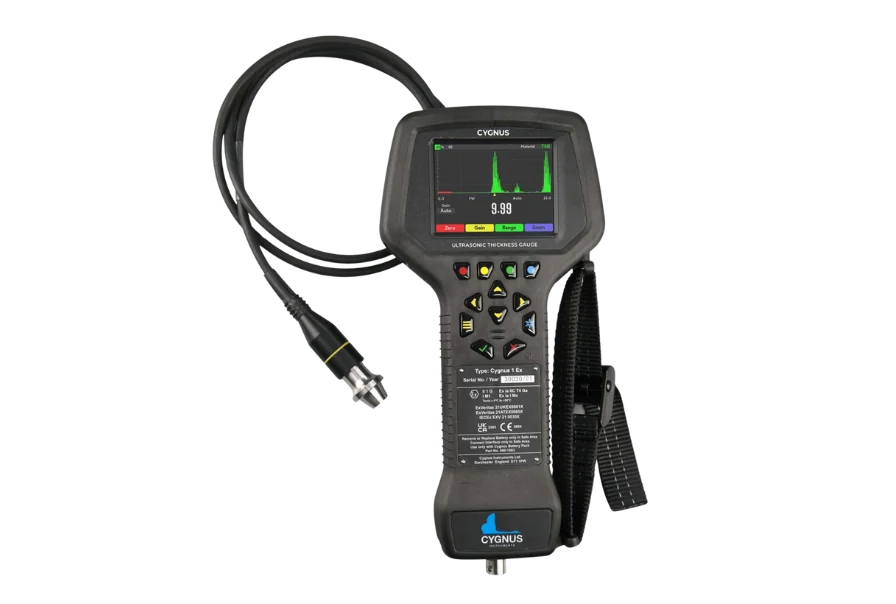
The Cygnus 1 Ex is described on its product page as an intrinsically safe ultrasonic thickness gauge designed to deliver accurate, through-coating metal thickness measurements in hazardous environments. The page states that it is certified to ATEX, IECEx, and UKEX standards and approved for use in gas Zones 0, 1, and 2; combustible dust Zones 21 and 22; and coal mines.
Hazardous-area markings shown on the product page:
- I.S. Class I Division 1 Groups A, B, C, D T4
- I.S. Class I Zone 0 AEx ia IIC Ga T4
- II 1G Ex ia IIC T4 Ga (ATEX / IECEx / UKEX, gas)
- II 2D Ex ib IIIB T100°C Db (ATEX / IECEx / UKEX, dust)
- I M1 Ex ia Ma (mining)
Offer on product page: For Rent
2. Cygnus 1
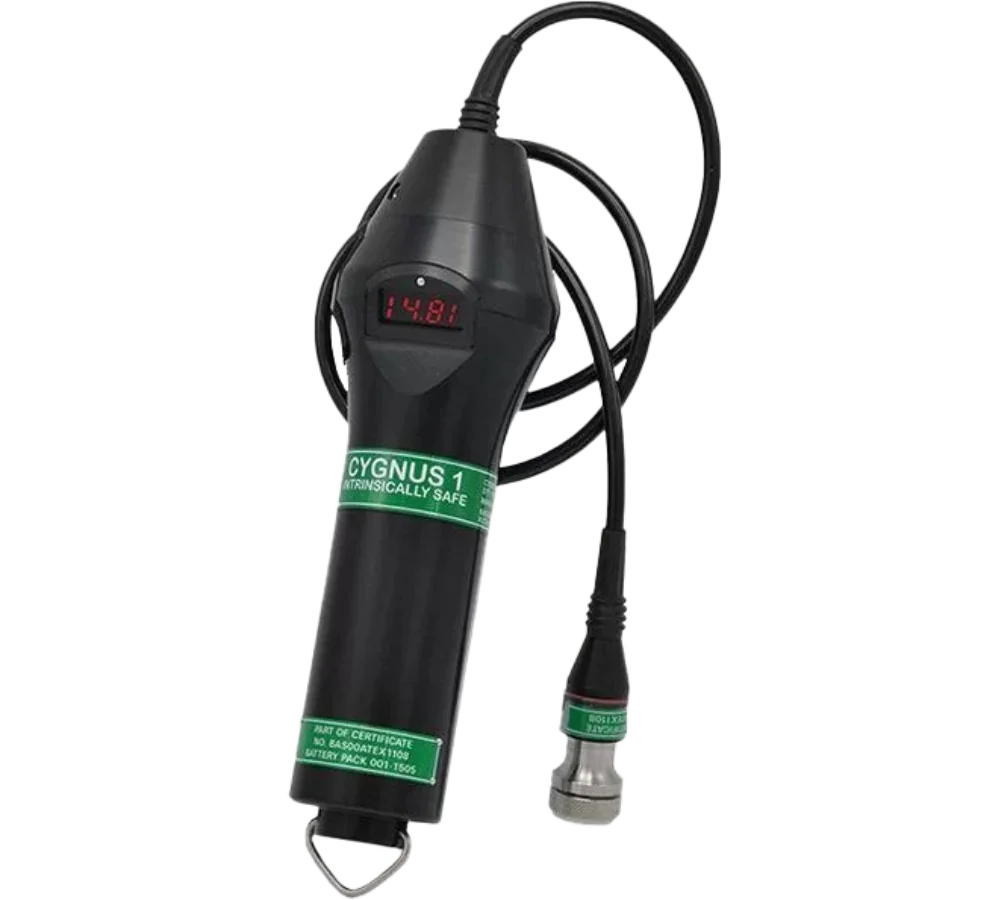
The Cygnus 1 is described on its product page as a heavy-duty ultrasonic thickness gauge made specifically for use in hazardous areas to measure corrosion in metal, without removing surface coatings.
Hazardous-area markings shown on the product page’s certification specification:
- {Ex} II 1 G Ex ia IIC T6 Ga
- {Ex} I M 1 Ex ia I Ma
- CSA Class 1 Group A, B, C & D
Offer on product page: For Rent
Visual inspection
Remote visual inspection inside pipes and lines in classified areas calls for a camera system rated for the location. See our guides to push cameras and inspection cameras for the wider category.
3. Pearpoint P374 IS
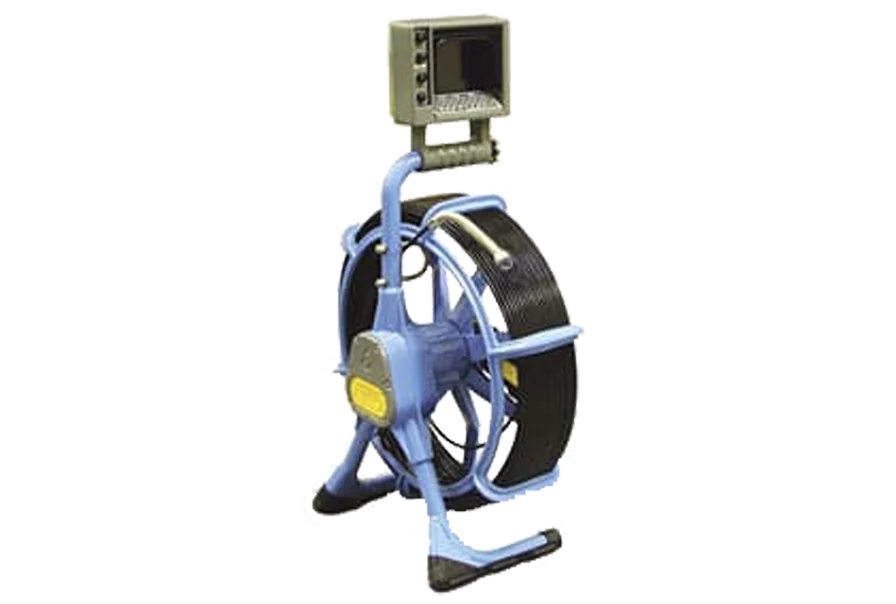
The Pearpoint P374 IS is described on its product page as an intrinsically safe inspection camera designed for hazardous environments: a fully integrated pushrod video inspection system with a stainless steel camera head and a built-in color display.
Hazardous-area statements on the product page (no marking string is listed):
- “Ideal for Zone 0 applications”
- “Certified for use in Class I, Division 1 locations”
Offer on product page: For Rent
Learn more about Pearpoint P374 IS
Gas monitoring
Personal and area gas monitors are often carried or placed in classified areas during inspection, maintenance, and turnaround work. Our gas leak detector guide covers detection methods more broadly.
4. Blackline Safety G8 Personal Gas Monitor
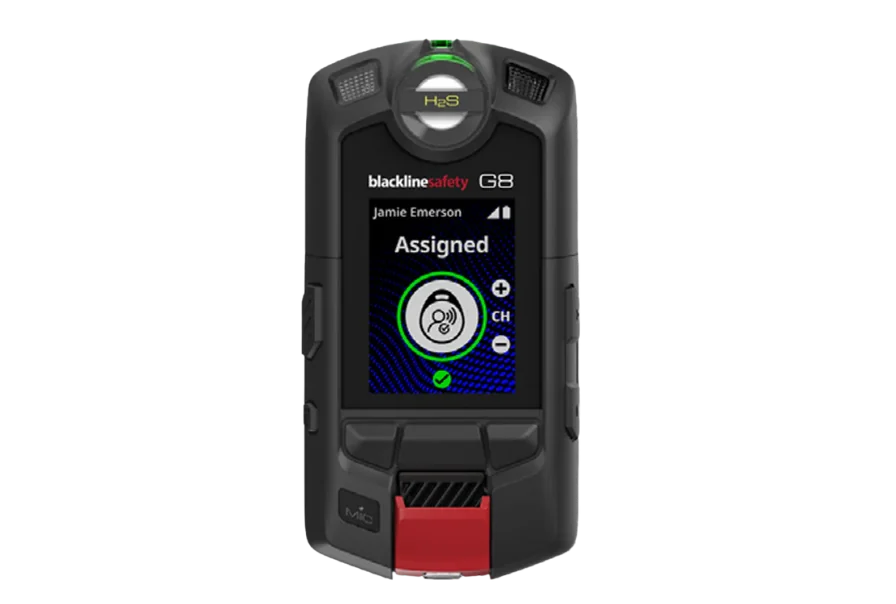
The Blackline Safety G8 is described on its product page as an all-in-one connected wearable that combines gas detection, lone worker monitoring, communication, and live data in a single device. The page says it can monitor up to five gases at once, within an intrinsically safe design built for hazardous environments.
Hazardous-area markings shown on the product page:
- Class I Division 1 Group A,B,C,D T4 (Canada and USA)
- Class I Zone 0 AEx ia IIC T4 (Canada and USA)
- Ex ia IIC T4 Ga (Canada and USA; IECEx; ATEX)
Offer on product page: For Rent
Learn more about Blackline Safety G8 Personal Gas Monitor
5. Blackline Safety EXO 8
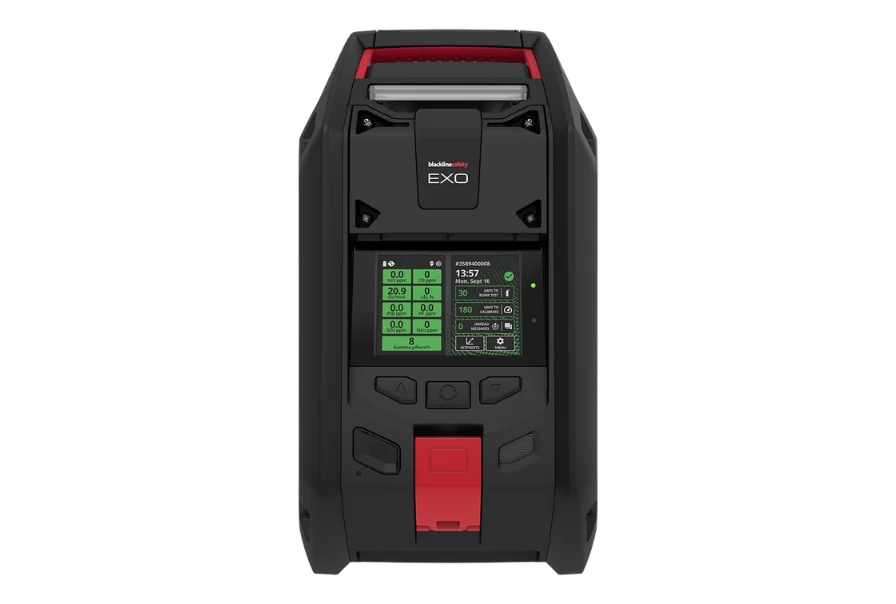
The Blackline Safety EXO 8 is described on its product page as a cloud-connected area monitor for hazard detection across industrial job sites. Using swappable cartridges and an optional expansion module, the page says it can monitor up to eight gases at once, along with optional gamma radiation detection. The page also describes its external signal ports as intrinsically safe.
Hazardous-area markings shown on the product page:
- Class I Division 1 Group A,B,C,D T3 (Canada and USA)
- Class I Zone 0 AEx ia IIC T3 (Canada and USA)
- Ex ia IIC T3 Ga (Canada and USA; IECEx; ATEX)
Offer on product page: For Rent
Learn more about Blackline Safety EXO 8 Area Gas & Radiation Monitor
Noise exposure monitoring
Personal noise dosimeters are worn for full shifts, so a worker who enters a classified area brings the dosimeter with them. See our noise dosimeter guide and sound level meter guide for the wider category.
6. TSI Quest Edge 8 Dosimeter
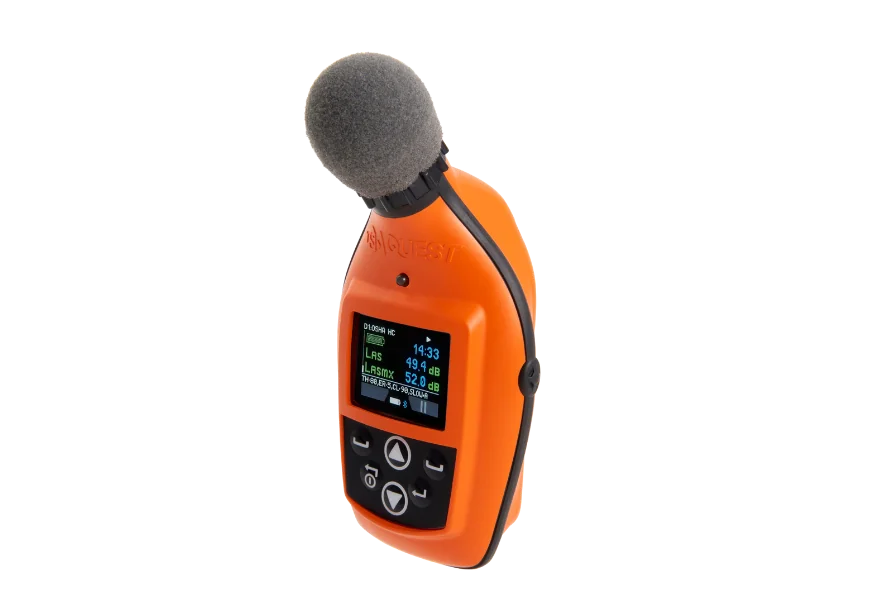
The TSI Quest Edge 8 is described on its product page as a durable, intrinsically safe instrument engineered for real-time monitoring of personal noise exposure in demanding work environments, with four independently configurable virtual dosimeters in one device.
Hazardous-area markings shown on the product page:
- UL (US/Canada): Class I, Div 1, Groups A, B, C, D T4
- ATEX: Ex ia IIC T4 Ga / Ex ia I Ma
- IECEx: Ex ia IIC T4 Ga / Ex ia I Ma
Offer on product page: Buy or Rent
Learn more about TSI Quest Edge 8 Dosimeter
7. Casella CEL-350IS
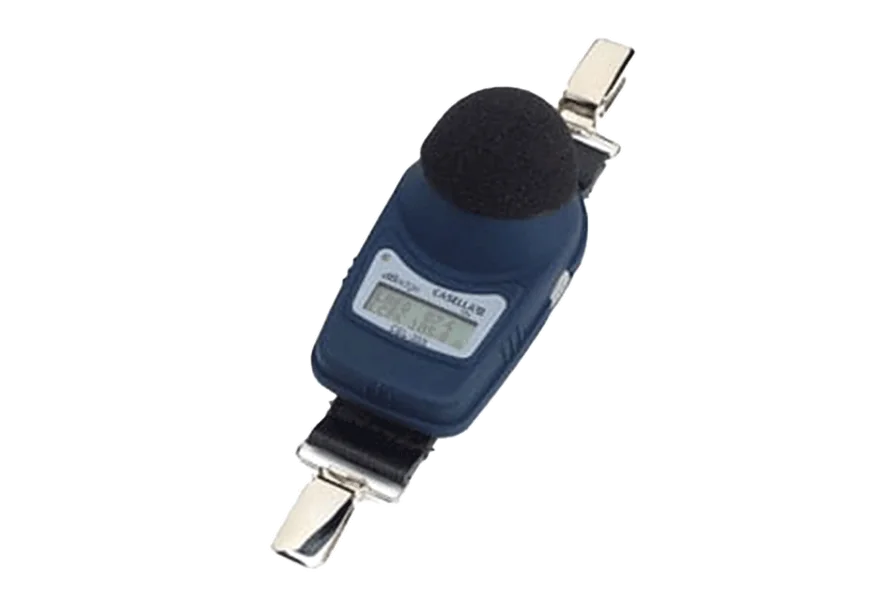
The Casella CEL-350IS is described on its product page as an intrinsically safe personal noise dosimeter designed for hazardous environments. The page states that it is intrinsically safe and has been IS approved.
Hazardous-area markings: the product page doesn’t list a marking. Check the instrument’s label and certificate for its rating.
Offer on product page: For Rent
Learn more about Casella CEL-350IS
Acoustic imaging and leak detection
Acoustic cameras locate leaks and faults by sound. This one has an intrinsically safe variant rated for Zone 2 only.
8. Sorama CAM iV64Ex
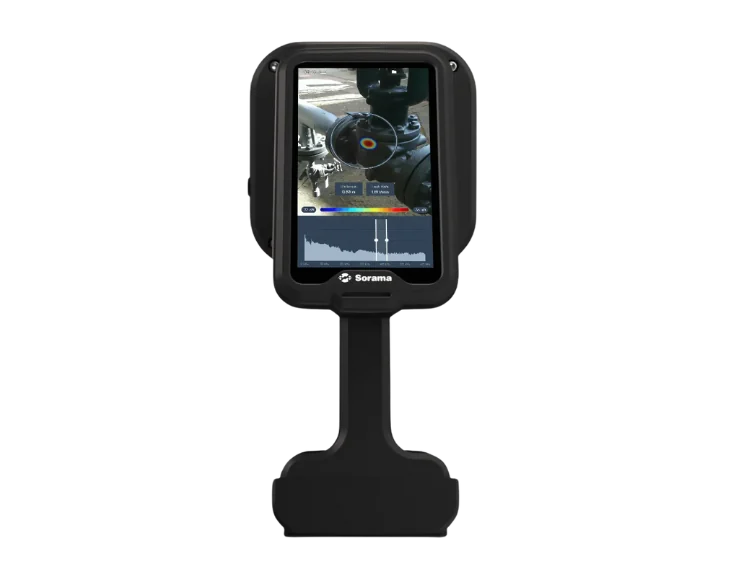
The Sorama CAM iV64Ex is the intrinsically safe version of the Sorama CAM iV64s handheld acoustic camera. The MFE product page says it delivers the capabilities of the iV64s in an intrinsically safe design certified for use in Zone 2 explosive atmospheres. It also notes that Wi-Fi, Bluetooth, USB-C, and battery swaps are disabled inside hazardous zones. The standard CAM iV64s is not the intrinsically safe model.
Hazardous-area ratings shown on the product page (iV64Ex):
- Zone 2; Equipment Group II; Category 3G
- Ex ic (Intrinsic Safety); Gas Group IIC; T4; EPL Gc
- Certifications: DEKRA 24ATEX0068X / IECEx DEK 24.0047X
Offer on product page: Buy or Rent
Frequently asked questions about intrinsically safe equipment
Are iPhones and other cell phones intrinsically safe?
A phone or tablet is intrinsically safe only if that specific model carries an intrinsically safe approval for your area, shown on its label and backed by a certificate. Don’t assume a phone is approved because of its brand, its ruggedness, or a protective case. A case doesn’t change the device’s certification, and an IP rating isn’t an ignition-protection rating. If a device has no hazardous-location marking, follow your site’s rules on whether it may enter a classified area at all.
Is intrinsically safe the same as non-incendive?
No. They are different protection techniques with different permitted locations. OSHA permits nonincendive circuits, equipment, and components in Class I, Division 2; Class II, Division 2; and Class III, Division 1 or 2, but not in Class I, Division 1. Intrinsically safe equipment is permitted in any hazardous (classified) location for which it is approved. See where non-incendive and other protection methods fit.
Can intrinsically safe equipment rated for Division 1 or Zone 0 be used in less hazardous areas?
Generally, yes, within the same material group. Under OSHA, equipment approved for a Division 1 location may be installed in a Division 2 location of the same class and group. Equipment listed for Zone 0 may be installed in Zone 1 or Zone 2 for the same gas or vapor, and Zone 1 equipment may be installed in Zone 2. The gas group and temperature class still have to fit the area.
Is intrinsically safe equipment required in Division 2 or Zone 2?
Not necessarily. OSHA lists several protection techniques permitted in Division 2 and Zone 2 locations, including nonincendive equipment (Division 2), type of protection “n” (Zone 2), and purged and pressurized equipment. Whether a particular method is acceptable for a particular job is a decision for the site and the authority having jurisdiction.
What does “Ex ia” mean?
“Ex” marks equipment for explosive atmospheres, “i” means intrinsic safety, and “a” is the highest of the three levels of protection. Under IEC 60079-11, level ia must not cause ignition in normal operation, with one countable fault, or with two countable faults. It is typically marked with EPL Ga, the protection level for Zone 0. The full marking still has to match your area’s gas group and temperature class; see how to read an intrinsically safe rating.
Who decides whether a tool can be used in a hazardous area?
The site does, under its area classification and the requirements of the authority having jurisdiction. The tool’s label and certificate show what it is approved for. The site’s classification documentation shows what each area requires. The seller or rental company doesn’t approve equipment for your site, and neither does the label alone. The comparison between the two is covered in how to check that a tool matches your area.
Standards and sources
- OSHA, 29 CFR 1910.307, Hazardous (classified) locations
- OSHA, 29 CFR 1910.399, Definitions applicable to Subpart S
- OSHA, Nationally Recognized Testing Laboratory (NRTL) Program
- IEC 60079-11, Explosive atmospheres – Part 11: Equipment protection by intrinsic safety “i” (current edition: 2023)
- IEC 60079-25, Explosive atmospheres – Part 25: Intrinsically safe electrical systems
- NFPA 70, National Electrical Code, Articles 500 and 505
- European Commission, Equipment for potentially explosive atmospheres (ATEX), Directive 2014/34/EU
- European Commission, ATEX 2014/34/EU Guidelines (sixth edition, January 2026)
- IECEx, the IEC System for Certification to Standards Relating to Equipment for Use in Explosive Atmospheres
- U.S. Coast Guard, Outer Continental Shelf National Center of Expertise, “The Drill Down” on hazardous location electrical markings: material groups (Issue 25), temperature class (Issue 27), and equipment protection level (Issue 28)
- Health and Safety Authority (Ireland), ATEX protection concepts