
- MFE Offshore Home
- /
- Hydromea EXRAY
Hydromea EXRAY
The Hydromea EXRAY is a compact, professional underwater ROV designed to simplify inspections in complex, submerged environments—including the ability to operate wirelessly in confined spaces where traditional tethered systems struggle.
Built for water-intensive infrastructure, it enables operators to capture high-quality visual and inspection data without draining assets or relying on divers. From hydropower systems and pipelines to dams and municipal water networks, the EXRAY helps identify critical issues like cracks, leaks, and structural damage with ease.
By combining agile maneuverability, untethered freedom of movement, advanced data collection, and intuitive mission software, the EXRAY™ streamlines the entire inspection process from deployment to reporting.
Its ability to operate efficiently in challenging conditions significantly reduces downtime, lowers operational costs, and eliminates safety risks, making it a powerful solution for modern underwater inspection and asset management.
Equipment Type: Underwater Inspection ROV
Benefits of the Hydromea EXRAY
- Hydropower turbine blade inspection
- Dam wall inspection
- Tunnel inspection
- Pipeline inspection
- Penstock inspection
- Gate structure inspection
- Ballast water tank inspection
- Municipal water system inspection
- Concrete structure inspection
- Foundation rock inspection
- Submerged infrastructure condition assessment
- Leak detection in submerged assets
- Crack detection in underwater structures
- Erosion monitoring in water-exposed assets
- Debris identification and assessment
- Offshore energy asset inspection
- Aquaculture facility inspection
- Defense-related underwater inspection
- Infrastructure security inspections
- Confined space underwater inspections
- Hydropower turbine blades
- Hydropower generators
- Dam walls
- Dam spillways
- Foundation rock structures
- Concrete water structures
- Water retention basins
- Penstocks
- Intake structures
- Outfall structures
- Gates
- Pipes
- Pipelines
- Tunnels
- Water conduits
- Ballast water tanks
- Storage tanks
- Municipal water distribution systems
- Wastewater systems
- Cooling water systems
- Offshore FPSO vessels
- Subsea infrastructure
- Aquaculture enclosures
- Flooded industrial chambers
- Hydropower
- Offshore energy
- Oil and gas
- Renewable energy
- Industrial water management
- Municipal water utilities
- Wastewater management
- Marine infrastructure
- Aquaculture
- Defense
- Infrastructure security
- Maritime operations
- Environmental monitoring
- Marine research
- Civil infrastructure
- Mining
- Chemical processing
- Power generation
For Rent
Talk to Wendy
Hydromea EXRAY for Confined Underwater Infrastructure Inspection Without Draining or Downtime
Inspecting submerged infrastructure has never been easy. Draining assets takes time, shutting down operations costs money, and sending divers into confined spaces comes with serious safety risks.
Whether you’re dealing with pipelines, dams, or turbine systems, getting clear, reliable data from underwater environments is often slow, expensive, and complicated.
The Hydromea EXRAY™ changes that by letting you inspect these assets exactly where they are. No draining, no downtime, and no putting people in harm’s way.
It’s a compact underwater robot built to navigate tight, hard to reach spaces while delivering the critical insights you need to catch problems early and keep operations running smoothly.
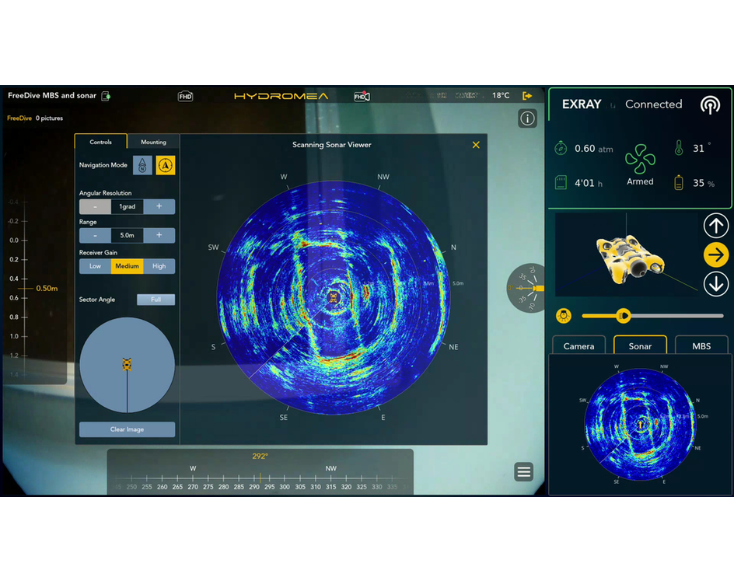
Compact Agile ROV with Advanced Sonar Navigation for Confined Inspections
The Hydromea EXRAY™ combines a compact, agile form factor with advanced sonar navigation to tackle some of the most challenging underwater inspection environments.
Weighing just 9 kg and measuring 600 x 378 x 134 mm, this man-portable ROV is designed for rapid deployment and can easily access tight spaces such as pipes as small as 60 cm in diameter.
Its 6 Degrees of Freedom (DOF) and rim-driven, hubless thrusters provide precise maneuverability while reducing the risk of entanglement, allowing operators to confidently navigate complex, debris-filled environments without interruption.
To support operations where visibility is limited or nonexistent, the EXRAY™ integrates advanced sonar systems, including scanning imaging sonar, multibeam sonar, and a Doppler Velocity Log (DVL).
This sensor fusion delivers a clear understanding of surroundings through multidimensional imaging, enabling stable navigation, accurate positioning, and reliable target identification even in murky or zero-visibility water.
Together, these capabilities ensure consistent data capture and safer, more efficient inspections in environments where traditional methods fall short.
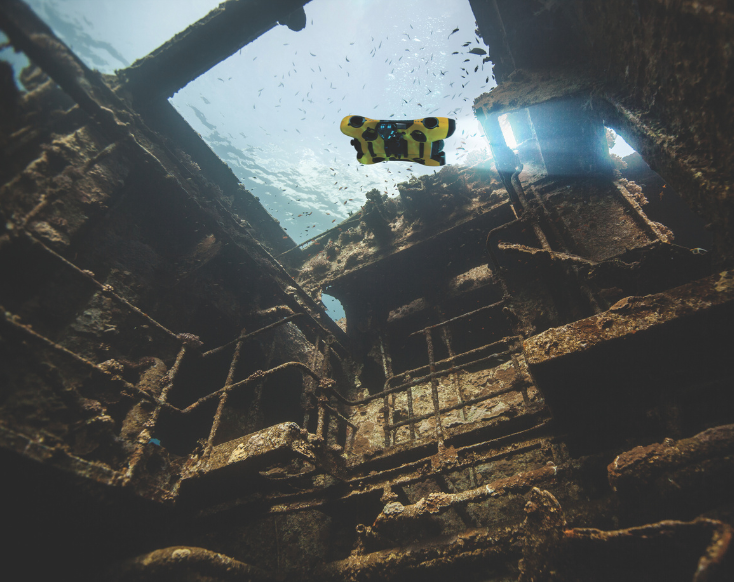
Hydromea EXRAY with Wireless FLYOUT Module and Real-Time Optical Communication for Untethered Inspections
The Hydromea EXRAY enhances operational flexibility with its optional FLYOUT module, enabling wireless inspections in the most complex submerged environments.
Using LUMA high-bandwidth optical communication technology, the system can stream real-time 1080p video while operating untethered up to 30 meters from its relay.
This allows the ROV to move freely through confined spaces such as ballast water tanks, eliminating the common risks associated with tether snags and entanglement.
By removing the physical limitations of a tether, operators gain greater control, improved maneuverability, and the ability to access areas that would otherwise be unreachable.
This not only increases mission success rates in tight, obstacle-filled environments but also reduces downtime caused by interruptions or retrieval issues.
The result is a more efficient and reliable inspection process, especially in scenarios where traditional tethered systems struggle to perform.
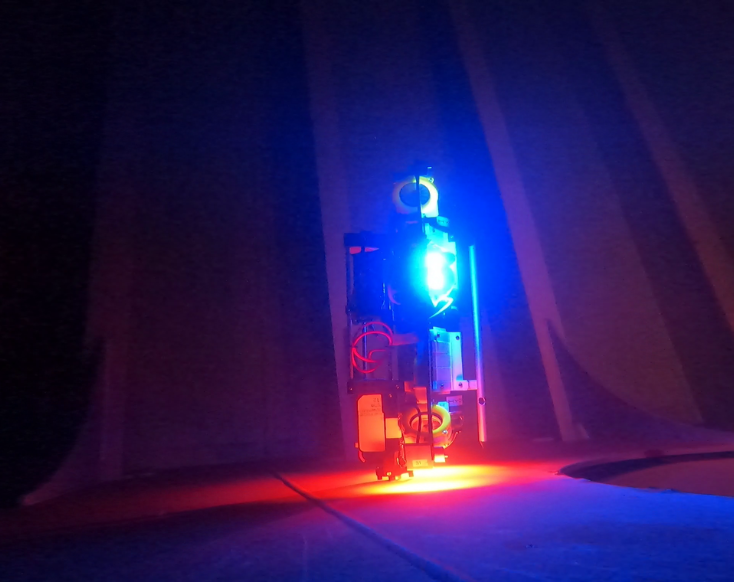
Integrated UT Sensors with High-Resolution Inspection Camera
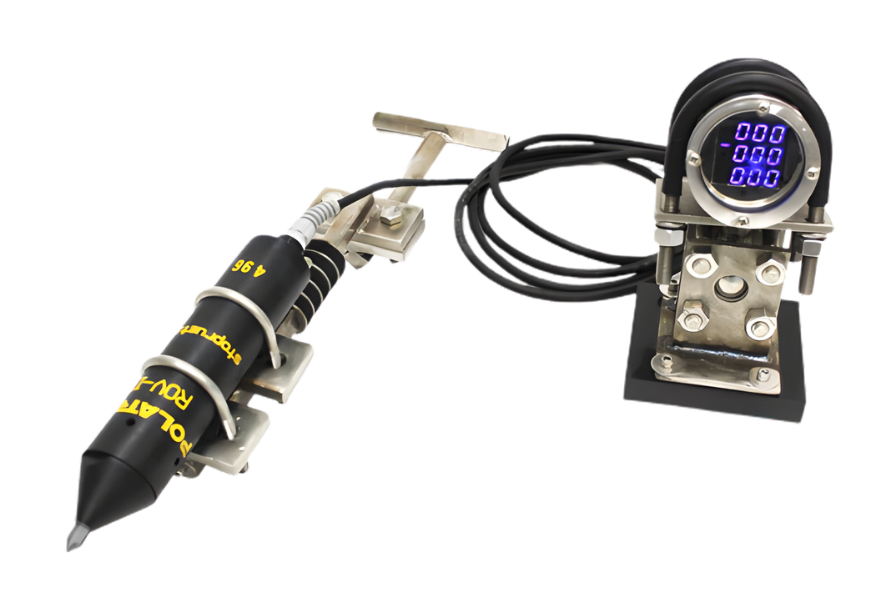
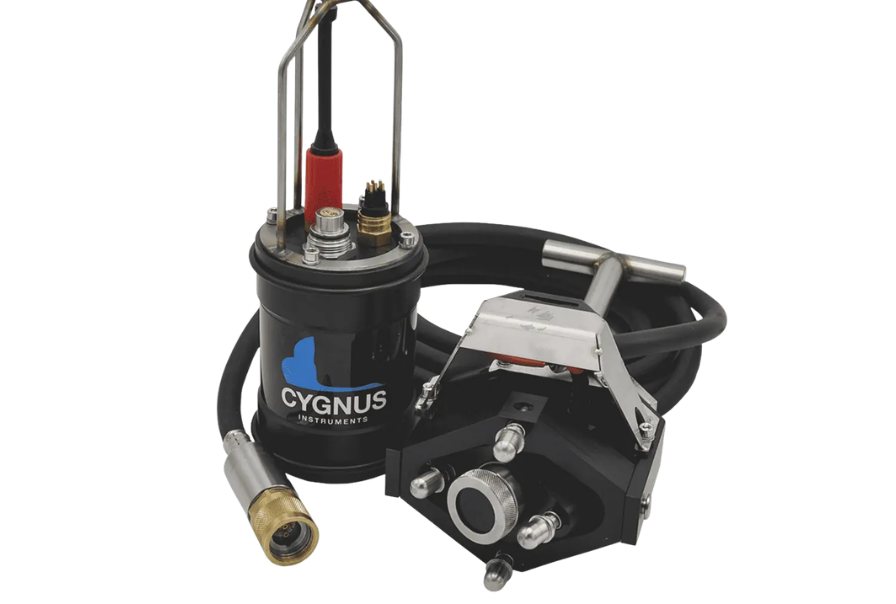
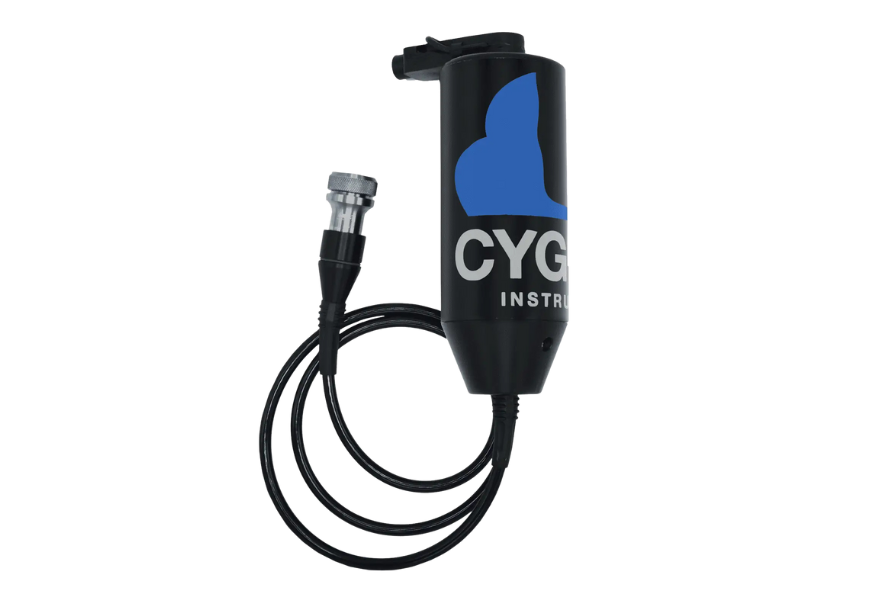
The Hydromea EXRAY pairs a high-resolution inspection camera with integrated ultrasonic thickness (UT) sensors to deliver a complete picture of asset health.
Its professional camera captures 4K images and Full HD video, supported by a 110° field of view, 3x optical zoom, and adjustable focus from close-range surfaces to distant structures.
This allows operators to clearly identify surface-level defects such as cracks, erosion, and deformation without removing assets from service.
Beyond visual inspection, the integrated Cygnus UT probes provide accurate thickness measurements, even on heavily corroded materials and through up to 1 mm of coating.
This means operators can detect hidden structural degradation that isn’t visible to the eye, eliminating guesswork and reducing the need for follow-up inspections.
Together, these technologies enable faster, more informed decision-making while minimizing downtime and ensuring critical infrastructure remains safe and operational.
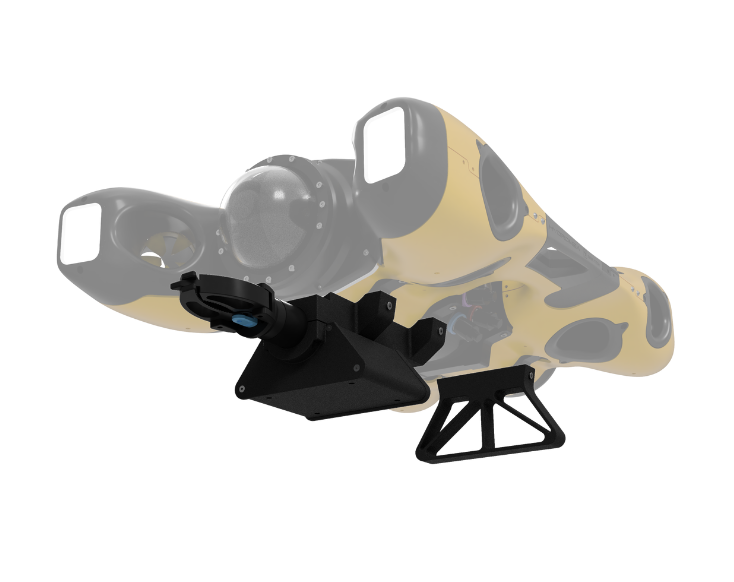
Modular Payload System with Real-Time NAVIA Mission Management
The Hydromea EXRAY™ is built around a plug-and-play modular payload system that adapts to a wide range of inspection challenges without adding complexity.
With multiple payload ports including Ethernet, Serial, and Gigabit connections, operators can easily integrate tools like a gripper for object retrieval or the SPEERA™ vacuum system for clearing debris.
The system automatically detects connected payloads and integrates their controls directly into the interface, eliminating the need for additional software and streamlining operation in the field.
This flexibility is paired with the NAVIA™ mission management platform, an intuitive software interface designed to simplify both piloting and reporting.
NAVIA™ supports dual-operator workflows with dedicated pilot and inspector stations, allowing one user to focus on navigation while the other logs data and annotations in real time.
It also enables live measurements, structured data capture, and instant report generation with geo-tagged points of interest.
The result is faster inspections, reduced operator workload, and immediate access to actionable insights as soon as the mission is complete.
Ready to Simplify Confined Space Underwater Inspections?
Confined, submerged environments are some of the hardest and most dangerous areas to inspect. The Hydromea EXRAY™ gives you a safer, faster way to capture critical data—without draining assets or sending personnel into high-risk spaces.
Whether you’re looking to buy or rent, MFE Offshore provides the equipment, expertise, and support to help you tackle even the most complex underwater inspections with confidence.
Contact MFE Offshore today to request a quote or schedule a demo.
Hydromea EXRAY Technical Specifications
| Dimensions (LxWxH) | 600 x 378 x 134 mm (23.62 x 14.88 x 5.28 in) |
| Weight in Air | 9 kg (20 lbs) |
| Weight in Fresh Water | Neutrally buoyant, with adjustable buoyancy for other environments |
| Depth Rating | 200 m (656 ft) |
| Max Speed | 1m/s (2 knots) forward/backward |
| Thrusters | Rim-driven hubless hydro-lubricated design. 4
vectored + 4 vertical.
Power Train Consumption: Hovering: 50 W Average: 70 W Strong Currents: 200 W |
| Dexterity | 6 DOF |
| Lights | Adjustable, up to a total of 4800 lumen |
| Construction | HDPE, anodized aluminum, POM |
| Video | FHD, 24 Hz, .mkv |
| Images | FHD, 4K, RAW, .jpeg |
| Tilt | ±70°; horizontal |
| Horizontal Field of View | 110° |
| Focal Length | 2.7-13 mm (0.11-0.51 in) |
| Optical Zoom | 2.5x - 3x (5 - 20 m (16 - 66 ft)) |
| Focus | Adjustable focus - from the camera dome surface to infinity, even while zoomed in. |
| Type | Twisted copper pair, ruggedized Optional: Single mode fiber up to 2,000 m (6,516 ft) |
| Length | 100 m (328 ft) |
| Diameter | 4 mm (0.16 in) low drag |
| Weight in Water | Neutrally buoyant |
| Minimum Breaking Strength | 155 kgf (342 lbf) |
| Type | Lithium Ion stackable (Max ROV load - 3 batteries) |
| Nominal Voltage | 14.4 V (maximum voltage 16.8 V) |
| Nominal Energy | 97.92 Wh per battery |
| Weight in Air | 415 g (0.9 lbs) per battery |
| Charge Time | 1 hour (0% → 80%) |
| Option | Batteries can be charged simultaneously directly inside the EXRAY™ |
| Operating Time | Between 4 to 6 hours |
| Internal Memory | 32 GB (10h recording), additional slot for a microSD card (256 GB max) |
| Operating Temperature | 0°C to 40°C (32°F to 104°F) |
| Aux Ports | 2x Serial RS232/RS485 and CANbus, 2x Ethernet 10/100, 1x Gigabit |
| Automation | Auto depth, auto pitch; station hold with optional DVL |
| IMU Sensor | 9 axes, accelerometer, magnetometer, gyroscope |
| Depth Sensor | 0 to 30 bar range, 0.2 mbar resolution |
| Optional Payload | Gripper, UT Sensor, DVL, Scanning Imaging Sonar, Multi-beam Sonar, SPEERA™ Vacuum Cleaner. (Page 6) |
| Dimensions for the Wireless System (LxWxH) | 629 x 378 x 321 mm (24.76 x 14.88 x 12.64 in) |
| Weight in Air | 18 kg (40 lbs) |
| Docking Rails (included payload) | Nominal Voltage: 11V - 16.8V
Nominal: Power 8 W Sensors: Positioning / locking Weight in Water: Neutrally buoyant |
| Optional Payload (Universal Ports) | When a payload is connected, the NAVIA™ intelligent management interface automatically recognizes it, making the payload's functions readily accessible through the NAVIA™ user interface. New payloads are continuously added to the EXRAY™ inventory and seamlessly integrated into the NAVIA™ interface. Hydromea also offers custom integration for any specific payload you need. |
 English
  English (Canada)
  Français du Canada